Genesis 31
1Now Jacob heard that Laban’s sons were saying, “Jacob has taken away all that belonged to our father and built all this wealth at our father’s expense.” 2And Jacob saw from the countenance of Laban that his attitude toward him had changed.
3Then YAHWEH said to Jacob: “Go back to the land of your fathers and to your kindred, and I will be with you.”
4So Jacob sent word and called Rachel and Leah to the field where his flocks were, 5and he told them, “I can see from your father’s countenance that his attitude toward me has changed; but the God of my father has been with me. 6Both of you know that I have served your father with all my strength. 7And although your father has cheated me and changed my wages ten times, God has not allowed him to harm me. 8If he said, ‘The speckled will be your wages,’ then the whole flock bore speckled offspring. If he said, ‘The streaked will be your wages,’ then the whole flock bore streaked offspring. 9Thus God has taken away your father’s livestock and given them to me.”
10“When the flocks were breeding, I saw in a dream that the streaked, spotted, and speckled males were mating with the females. 11In that dream the Angel of God said to me, ‘Jacob!’ And I replied, ‘Here I am.’
12‘Look up,’ he said, ‘and see that all the males that are mating with the flock are streaked, spotted, or speckled; for I have seen all that Laban has done to you. 13I am the God of Bethel, where you anointed the pillar and made a solemn vow to Me. Now get up, leave this land at once, and return to your native land.’”
Genesis 31:10–13 Commentary
The Angel of God Reminds Jacob of an Old Vow:
The “Angel of God” who speaks to Jacob in this dream is the Messenger of YAHWEH, the pre-incarnate Yeshua. The Angel points Jacob back to his solemn encounter three chapters earlier at Bethel (Genesis 28:18–22), calling him to arise and return to his homeland. Twenty years later, God is calling him back to that sacred commitment. God does not forget what you promised Him, even when you have forgotten.
The Angel of Bethel Is YAHWEH on the Ladder:
In verse 13 (Genesis 31:13), the Angel of God doesn’t stay in the third person. He says, “I am the God of Bethel, where you anointed the pillar and made a solemn vow to Me.” Go back three chapters to Bethel in Genesis 28:13 and ask who was standing at the top of the ladder: YAHWEH, saying He was the God of Abraham and Isaac. Now ask who reminds Jacob of Bethel twenty years later: the Angel of God, speaking as the God of Bethel. They are the same Person. The Angel of God is the YAHWEH of the ladder, the Word, carrying the Father’s name and speaking with the Father’s authority, which is why Jacob can treat the Angel’s word as God’s own.
14And Rachel and Leah replied, “Do we have any portion or inheritance left in our father’s house? 15Are we not regarded by him as outsiders? Not only has he sold us, but he has certainly squandered what was paid for us. 16Surely all the wealth that God has taken away from our father belongs to us and to our children. So do whatever God has told you.”
17Then Jacob got up and put his children and his wives on camels, 18and he drove all his livestock before him, along with all the possessions he had acquired in Paddan-aram, to go to his father Isaac in the land in Canaan.
19Now while Laban was out shearing his sheep, Rachel stole her father’s household idols. 20Moreover, Jacob deceived Laban the Aramean by not telling him that he was running away.
21So he fled with all his possessions, crossed the Euphrates, and headed for the hill country of Gilead.
Genesis 31:14–21 Commentary
Why Rachel and Leah Flip on Laban:
Rachel and Leah acknowledge to Jacob that they no longer belong to their father’s household at all, siding with him rather than Laban. In ancient Near Eastern custom, the fourteen years of labor Jacob gave for his wives was supposed to be treated as a dowry trust fund kept safe for the daughters. Laban didn’t just mismanage it — he straight up spent it all on himself. Rachel and Leah aren’t just being dramatic; they are calling out a deadbeat dad who legally and financially bankrupted them.
Rachel’s Stolen Idols Reveal Lingering Paganism:
The Hebrew text identifies the stolen household gods as teraphim (Genesis 31:19). In ancient Near Eastern culture, as documented in the legal tablets from Nuzi, holding the family teraphim was not merely an act of private devotion; possession of these household gods established legal title to the family estate and conferred leadership over the ancestral inheritance. Rachel’s theft was a calculated countermeasure against Laban, who had squandered her rightful dowry. By seizing the teraphim, she secured legal leverage for her children's future. At the same time, their presence exposes the lingering pagan contamination still entwined with Jacob’s extended household — an idolatry Jacob must confront and bury four chapters later at Bethel in Genesis 35:2. Jacob then departs secretly across the Euphrates, knowing Laban would stop him by force.
22On the third day Laban was informed that Jacob had fled. 23So he took his relatives with him, pursued Jacob for seven days, and overtook him in the hill country of Gilead. 24But that night God came to Laban the Aramean in a dream and warned him: “Be careful not to say anything to Jacob, either good or bad.”
25Now Jacob had pitched his tent in the hill country of Gilead when Laban overtook him, and Laban and his relatives camped there as well. 26Then Laban said to Jacob, “What have you done? You have deceived me and carried off my daughters like captives of war! 27Why did you run away secretly and deceive me, without even telling me? I would have sent you away with joy and singing, with tambourines and harps. 28But you did not even let me kiss my grandchildren and my daughters goodbye. Now you have done a foolish thing.
29I have power to do all of you great harm, but last night the God of your father said to me, ‘Be careful not to say anything to Jacob, either good or bad.’ 30Now you have gone off because you long for your father’s house. But why have you stolen my gods?”
Genesis 31:22–30 Commentary
God Warns Laban Outside the Covenant:
Laban stands entirely outside the covenant line, yet God intervenes directly to warn him not to harm Jacob — a reminder that God commands kings and outsiders alike to protect His chosen line. Laban tries to cover his tracks with some top-tier gaslighting, whining that he would have sent Jacob off with a massive celebration, music, and kisses if he’d only known. It’s pure theater. If God hadn’t personally ambushed Laban in a dream the night before and strictly warned him not to touch Jacob (Genesis 31:24, 29), Laban wouldn’t be throwing a party — he’d be stripping Jacob of everything he owned.
Some Men Cling to Idols Even When Warned:
Laban’s attachment to his household gods exposes his continuing idolatry, frantically hunting for stolen figurines right after God had just spoken to him directly.
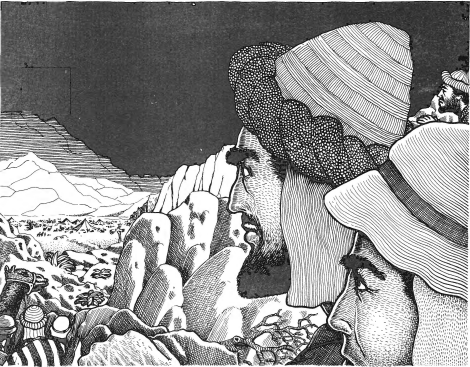
31“I was afraid,” Jacob answered, “for I thought you would take your daughters from me by force. 32If you find your gods with anyone here, he shall not live! In the presence of our relatives, see for yourself if anything is yours, and take it back.” (For Jacob did not know that Rachel had stolen the idols.)
33So Laban went into Jacob’s tent, then Leah’s tent, and then the tents of the two maidservants, but he found nothing. Then he left Leah’s tent and entered Rachel’s tent. 34(Now Rachel had taken Laban’s household idols, put them in the saddlebag of her camel, and was sitting on them.) And Laban searched everything in the tent but found nothing.
35Rachel said to her father, “Sir, do not be angry that I cannot stand up before you; for I am having my period.” So Laban searched but could not find the household idols.
36Then Jacob became incensed and challenged Laban. “What is my crime?” he said. “For what sin of mine have you so hotly pursued me?”
Genesis 31:31–36 Commentary
Jacob’s Bold Vow Is Reckless Overconfidence:
Jacob declares that whoever is found with the idols shall not live, unaware that his beloved Rachel had hidden them (Genesis 31:32). The moment stands as a caution against speaking rashly before all the facts are in. Rachel claims she cannot rise before her father because she is experiencing “the custom of women,” successfully concealing the idols inside her camel saddle beneath her. When Laban finishes ransacking every tent and comes up completely empty-handed, Jacob turns the tables in genuine, righteous fury, demanding to know his crime — and for once in his life, he is the one standing entirely in the truth.
Jacob’s Rash Oath Shadows Rachel’s Death:
That careless death oath casts an eerie shadow forward: Rachel dies in childbirth four chapters later on the road near Bethlehem (Genesis 35:16–19). Scripture never says the oath caused her death, and it shouldn’t be pressed as direct cause and effect. But ancient Jewish tradition draws that line, and the proximity of the two scenes is a stark warning: a rash oath can land heavy on the people we love.
37“You have searched all my goods! Have you found anything that belongs to you? Put it here before my brothers and yours, that they may judge between the two of us.
38I have been with you for twenty years now. Your sheep and goats have not miscarried, nor have I eaten the rams of your flock. 39I did not bring you anything torn by wild beasts; I bore the loss myself. And you demanded payment from me for what was stolen by day or night. 40As it was, the heat consumed me by day and the frost by night, and sleep fled from my eyes.
41Thus for twenty years I have served in your household—fourteen years for your two daughters and six years for your flocks—and you have changed my wages ten times! 42If the God of my father, the God of Abraham and the Fear of Isaac, had not been with me, surely by now you would have sent me away empty-handed. But God has seen my affliction and the toil of my hands, and last night He rendered judgment.”
43But Laban answered Jacob, “These daughters are my daughters, these sons are my sons, and these flocks are my flocks! Everything you see is mine! Yet what can I do today about these daughters of mine or the children they have borne? 44Come now, let us make a covenant, you and I, and let it serve as a witness between you and me.”
Genesis 31:37–44 Commentary
Jacob’s Labor Vindicated by “the Fear of Isaac”:
Jacob recounts his twenty years of exhausting labor under Laban, describing harsh exposure to scorching heat by day, freezing frost by night, and sleepless vigilance. In Genesis 31:42 and verse 53 (Genesis 31:53), he invokes "the Fear of Isaac" — an extraordinary and profound title for God, emphasizing the reverent, trembling awe with which Isaac walked before YAHWEH. When Laban realizes he cannot intimidate Jacob, he formally proposes a mutual non-aggression covenant at Galeed (Genesis 31:44), essentially cutting a peace treaty to establish a permanent boundary between them.
45So Jacob picked out a stone and set it up as a pillar, 46and he said to his relatives, “Gather some stones.” So they took stones and made a mound, and there by the mound they ate. 47Laban called it Jegar-sahadutha, and Jacob called it Galeed.
48Then Laban declared, “This mound is a witness between you and me this day.” (Therefore the place was called Galeed.) 49It was also called Mizpah, because Laban said, “May YAHWEH keep watch between you and me when we are absent from each other. 50If you mistreat my daughters or take other wives, although no one is with us, remember that God is a witness between you and me.”
51Laban also said to Jacob, “Here is the mound, and here is the pillar I have set up between you and me. 52This mound is a witness, and this pillar is a witness, that I will not go past this mound to harm you, and you will not go past this mound and pillar to harm me. 53May the God of Abraham and the god of Nahor, the god of their father, judge between us.” So Jacob swore by the Fear of his father Isaac.
54Then Jacob offered a sacrifice on the mountain and invited his relatives to eat a meal. And after they had eaten, they spent the night on the mountain. 55Early the next morning, Laban got up and kissed his grandchildren and daughters and blessed them. Then he left to return home.
Genesis 31:45–55 Commentary
Two Names, Two Languages — Aramaic and Hebrew:
Jacob sets up a stone pillar and his men gather stones into a memorial mound to mark the boundary between them (Genesis 31:45–46). Laban names it Jegar-sahadutha in Aramaic while Jacob names it Galeed in Hebrew — both meaning “heap of witness” — showing that although they shared family roots, their branches spoke distinct Semitic languages. The site also picks up a third name, Mizpah, meaning “watchtower,” tied to Laban’s parting words: “May YAHWEH keep watch between you and me when we are absent from each other” (Genesis 31:49) — a line still quoted as a warm benediction today by people who never realized it was originally a mutual threat between two men who did not trust each other an inch.
Laban Invokes Regional gods; Jacob Swears by One:
Look at the Hebrew grammar in verse 53 (Genesis 31:53). Laban says, “May the God of Abraham and the god of Nahor, the god of their father, judge between us” — and the Hebrew verb for “judge” (yishpetu) is grammatically plural: “may they judge.” Laban is invoking Abraham’s God alongside Nahor’s god and Terah’s gods. This reflects the ancient divine council reality established twenty chapters earlier at Babel: when YAHWEH divided humanity, He disinherited the rebellious nations and placed them under subordinate celestial rulers (Deuteronomy 32:8–9). Nahor and Terah remained beyond the Euphrates worshiping those regional territorial gods — as Joshua exposes five centuries later in Joshua 24:2. Laban hedges his bets by pairing the true God with local deities. Jacob refuses the polytheistic compromise: he swears exclusively by the “Fear of his father Isaac,” binding himself to the one true Creator alone.
Eating Bread as Covenant Table Fellowship:
In Genesis 31:54, Jacob offers a sacrifice on the mountain and invites his kinsmen to “eat bread” — a foundational Hebrew idiom for sharing a covenant meal. In the ancient Near East, dining together after sworn oaths was not an ordinary meal; it legally sealed the treaty into a binding peace pact before God. This mirrors the hospitality Abraham extended to his divine visitors thirteen chapters earlier back in Genesis 18:5, and foreshadows the shared covenant fellowship echoed two millennia later when the early apostolic believers broke bread from house to house in Acts 2:46. By breaking bread together upon the mountain, the two men officially ratify their non-aggression boundary.
Laban’s Desperate Attempt to Salvage His Dignity:
When Laban demands that Jacob take no other wives, the posturing is almost tragic. He doesn’t even count the concubines as real wives — they were just surrogates. For twenty years, Laban was the ultimate apex predator of schemes. Now, completely outmaneuvered, financially broken, and having lost his entire family to the God he tried to cheat, his final desperate act is trying to salvage a shred of dignity by acting like a protective father.
Genesis 31:1–9 Commentary
Faithfulness Never Depended on Jacob’s Merit:
The moment Laban’s sons start grumbling and Laban’s smile turns icy, YAHWEH gives Jacob the marching orders: pack up and head home (Genesis 31:1–3). Jacob explains to his wives that the striped and speckled breeding explosion was never a magical folk remedy — God was actively dismantling Laban’s rigged wage contracts and transferring the livestock by His own hand (Genesis 31:7–9). The Almighty blessed and shielded Jacob despite his glaring flaws, proving once again that covenant promises don't wait around for human perfection.