Genesis 33
1Now Jacob looked up and saw Esau coming toward him with four hundred men. So he divided the children among Leah, Rachel, and the two maidservants. 2He put the maidservants and their children in front, Leah and her children next, and Rachel and Joseph at the rear. 3But Jacob himself went on ahead and bowed to the ground seven times as he approached his brother.
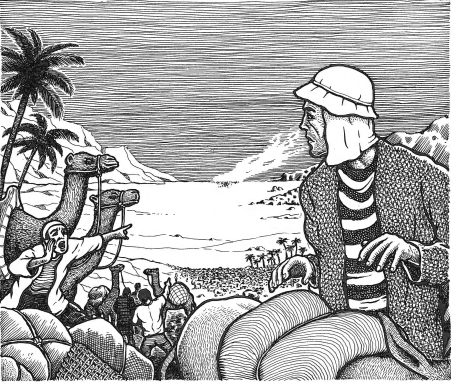
4Esau, however, ran to him and embraced him, threw his arms around his neck, and kissed him. And they both wept.
5When Esau looked up and saw the women and children, he asked, “Who are these with you?” Jacob answered, “These are the children God has graciously given your servant.” 6Then the maidservants and their children approached and bowed down. 7Leah and her children also approached and bowed down, and then Joseph and Rachel approached and bowed down.
8“What do you mean by sending this whole company to meet me?” asked Esau. “To find favor in your sight, my lord,” Jacob answered.
9“I already have plenty, my brother,” Esau replied. “Keep what belongs to you.”
10But Jacob insisted, “No, please! If I have found favor in your sight, then receive this gift from my hand. For indeed, I have seen your face, and it is like seeing the face of God, since you have received me favorably. 11Please accept my gift that was brought to you, because God has been gracious to me and I have all I need.” So Jacob pressed him until he accepted.
Genesis 33:4–11 Commentary
Esau’s Prosperity Enables His Generous Grace:
Leading four hundred mounted men means Esau has become a powerful, wealthy desert chieftain in his own right. He can easily afford to forgive Jacob because he no longer needs Isaac’s stolen blessing to prosper — he has already carved out an empire of his own. Jacob presses the gift on him again until Esau finally accepts it.
“Like Seeing the Face of God” Echoes Peniel:
Listen to what Jacob says in verse 10 (Genesis 33:10): “I have seen your face, and it is like seeing the face of God, since you have received me favorably.” The night before, at Peniel, he said he had seen God face to face (Genesis 32:30). Now he looks into the face of the brother he cheated, finds forgiveness there, and says it is like looking at the face of God. A man who has just been wrestled into humility now sees grace on a human face and knows exactly what he’s looking at. Genesis wants you to hear that the same Jacob who limped away from God’s face walks toward his brother’s and finds mercy in both.
12Then Esau said, “Let us be on our way, and I will go ahead of you.”
13But Jacob replied, “My lord knows that the children are frail, and I must care for sheep and cattle that are nursing their young. If they are driven hard for even a day, all the animals will die. 14Please let my lord go ahead of his servant. I will continue on slowly, at a comfortable pace for the livestock and children, until I come to my lord at Seir.”
15“Let me leave some of my people with you,” Esau said. But Jacob replied, “Why do that? Let me find favor in the sight of my lord.”
16So that day Esau started on his way back to Seir, 17but Jacob went on to Succoth, where he built a house for himself and shelters for his livestock (that is why the place was called Succoth).
18After Jacob had come from Paddan-aram, he arrived safely at the city of Shechem in the land of Canaan, and he camped just outside the city.
Genesis 33:12–18 Commentary
Reconciliation Doesn’t Mean Blind Trust:
Jacob asks Esau to go on ahead, citing the tender condition of his nursing flocks and young children, politely declining an escort of four hundred armed men. Jacob’s excuse about vulnerable cattle is brilliant tactical misdirection: Esau offers to guide him south to Seir; Jacob nods, promises to follow slowly, and then immediately hooks a hard turn west toward Succoth. Forgiveness is genuine, but Jacob knows that healthy boundaries are still mandatory.
Succoth Prefigures the Feast of Tabernacles:
He journeys to Succoth and builds shelters there, giving the place its name — the Hebrew word is Sukkot, meaning booths, the same word behind the Feast of Sukkot, or Tabernacles, that God would command Israel to keep nearly five centuries later in the wilderness (Leviticus 23:42–43) — then arrives safely at Shechem in the land of Canaan.
Jacob’s Shechem Land — The Well of John 4:
When Jacob buys this parcel of land in Shechem, he eventually digs a well that anchors future biblical history. This exact piece of real estate borders Sychar — the very plot where, nearly two millennia later, Yeshua the Messiah would meet the Samaritan woman at the well (John 4:5–14) and deliver His first explicit, direct revelation of His messianic identity.
19And the plot of ground where he pitched his tent, he purchased from the sons of Hamor, Shechem’s father, for a hundred pieces of silver. 20There he set up an altar and called it El-Elohe-Israel.
Genesis 33:19–20 Commentary
Jacob Steps Out of His Ancestors’ Shadow:
Jacob erects an altar there and calls it El-Elohe-Israel (“God, the God of Israel”) — a name that honors his new covenant identity as much as it honors God Himself. This brings full circle the solemn vow Jacob uttered twenty years earlier five chapters back at Bethel: that if God brought him back safely, “YAHWEH will be my God” (Genesis 28:21). The God of Abraham and Isaac has now become Jacob’s God by personal covenant. By dedicating this altar, Jacob ceases living on borrowed faith and seals the covenant in his own new name.
Genesis 33:1–3 Commentary
Jacob Ranks His Family by Affection:
Jacob looks up and sees Esau approaching with four hundred men. The moment he has been dreading finally arrives, and he arranges his family strategically: the maidservants and their children first, Leah and her children next, and Rachel with Joseph last, in the most protected position. That order alone tells you exactly where Jacob’s deepest affection still lay.