Genesis 37
1Now Jacob lived in the land where his father had resided, the land of Canaan.
2This is the account of Jacob. When Joseph was seventeen years old, he was tending the flock with his brothers, the sons of his father’s wives Bilhah and Zilpah, and he brought their father a bad report about them.
3Now Israel loved Joseph more than his other sons, because Joseph had been born to him in his old age; so he made him a robe of many colors. 4When Joseph’s brothers saw that their father loved him more than any of them, they hated him and could not speak a kind word to him.
5Then Joseph had a dream, and when he told it to his brothers, they hated him even more. 6He said to them, “Listen to this dream I had: 7We were binding sheaves of grain in the field, and suddenly my sheaf rose and stood upright, while your sheaves gathered around and bowed down to mine.”
8“Do you intend to reign over us?” his brothers asked. “Will you actually rule us?” So they hated him even more because of his dream and his statements.
9Then Joseph had another dream and told it to his brothers. “Look,” he said, “I had another dream, and this time the sun and moon and eleven stars were bowing down to me.”
10He told his father and brothers, but his father rebuked him and said, “What is this dream that you have had? Will your mother and brothers and I actually come and bow down to the ground before you?” 11And his brothers were jealous of him, but his father kept in mind what he had said.
Genesis 37:5–11 Commentary
Sun, Moon, and Stars — The Whole Family Bows:
Joseph’s first dream pictures his brothers’ sheaves bowing down to his own — an image bold enough to explain why they hate him for it. The second dream expands the prophecy, using sun, moon, and stars imagery that will reappear nearly two millennia later in John's apocalyptic vision in Revelation 12:1 to picture national Israel. Jacob immediately grasps the symbolism in verse 10 (Genesis 37:10): the sun is the patriarch, the moon is the mother, and the eleven stars are the brothers. Because Rachel had already died on the journey to Ephrath two chapters back (Genesis 35:19), Jacob’s mention of “your mother” most naturally points to Leah, the surviving matriarch of the household. Yet Jacob does not dismiss the revelation.
12Some time later, Joseph’s brothers had gone to pasture their father’s flocks near Shechem. 13Israel said to him, “Are not your brothers pasturing the flocks at Shechem? Get ready; I am sending you to them.” “I am ready,” Joseph replied.
14Then Israel told him, “Go now and see how your brothers and the flocks are faring, and bring word back to me.” So he sent him off from the Valley of Hebron. And when Joseph arrived in Shechem, 15a man found him wandering in the field and asked, “What are you looking for?”
16“I am looking for my brothers,” Joseph replied. “Can you please tell me where they are pasturing their flocks?”
17“They have moved on from here,” the man answered. “I heard them say, ‘Let us go to Dothan.’” So Joseph set out after his brothers and found them at Dothan.
Genesis 37:12–17 Commentary
An Unnamed Stranger Quietly Steers God’s Purpose:
The brothers are pasturing the flock near Shechem — the very city where Simeon and Levi had carried out their vigilante slaughter just three chapters earlier in Genesis 34. The “terror of God” that had supernaturally protected Jacob’s family from local retaliation back in Genesis 35:5 was still holding, allowing the brothers to graze their flocks unhindered. Shechem was also sacred patriarchal ground: it was the very site where Abraham first built an altar upon entering Canaan twenty-five chapters earlier (Genesis 12:6), and where Jacob had subsequently purchased land (Genesis 33:19). When Joseph arrives, an unnamed stranger directs him northward to Dothan — a quiet detail of God’s providence orchestrating macro-history through an anonymous man’s directions.
Dothan — From Joseph’s Pit to Elisha’s Fiery Host:
Dothan is an exceedingly rare geographic name in Scripture. It shows up in only two accounts in the entire Hebrew Bible: right here, where Joseph is about to be cast into a pit and sold by his brothers in the verses immediately following, and nearly a millennium later in 2 Kings 6:13–17, where the king of Aram surrounds Elisha at Dothan and the prophet prays that his terrified servant’s eyes be opened. The servant sees the hills full of horses and chariots of fire all around Elisha. The same ground where Joseph is about to be handed over into slavery by his own brothers is the ground where the unseen host of heaven visibly stands guard centuries later. Joseph could not yet see the Almighty’s unseen hand at work, but God was sovereignly governing every step of his journey all the same.
18Now Joseph’s brothers saw him in the distance, and before he arrived, they plotted to kill him. 19“Here comes that dreamer!” they said to one another. 20“Come now, let us kill him and throw him into one of the pits. We can say that a vicious animal has devoured him. Then we shall see what becomes of his dreams!”
21When Reuben heard this, he tried to rescue Joseph from their hands. “Let us not take his life,” he said. 22“Do not shed his blood. Throw him into this pit in the wilderness, but do not lay a hand on him.” (Reuben said this so that he could rescue Joseph from their hands and return him to his father.)
23So when Joseph came to his brothers, they stripped him of his robe—the robe of many colors he was wearing— 24and they took him and threw him into the pit. Now the pit was empty, with no water in it.
25And as they sat down to eat a meal, they looked up and saw a caravan of Ishmaelites coming from Gilead. Their camels were carrying spices, balm, and myrrh on their way down to Egypt.
26Then Judah said to his brothers, “What profit will we gain if we kill our brother and cover up his blood? 27Come, all of you, let us sell him to the Ishmaelites and not lay our hand on him; for he is our brother, our own flesh.” And they agreed.
Genesis 37:18–27 Commentary
Reuben’s Half-Measure — The Man “Unstable as Water”:
Reuben attempts to save Joseph’s life without directly confronting his brothers, proposing they throw him into a dry cistern so he might return secretly to rescue him (Genesis 37:21–22). He cannot bring himself to confront them openly — a moral instability that matches Jacob’s future deathbed assessment twelve chapters ahead in Genesis 49:4. Benjamin, the youngest, had remained home in Hebron with Jacob. When the merchant caravan approaches, Judah steps in with a cold calculation: why kill their brother and cover his blood when they can turn a profit and sell him into slavery? While Judah’s motive is mercenary, his intervention spares Joseph from immediate execution.
Twenty Shekels — The Going Rate for a Slave:
Ancient Near Eastern legal records surveyed by Kenneth Kitchen confirm this exact price belongs to the early second millennium BCE, the historical window Joseph lived in. That number is a problem for anyone who wants to claim Moses (or some later scribe) invented this story centuries afterward, because slave prices didn’t stay flat over the centuries — they climbed with inflation, the same as everything else. A scribe writing during the exile, centuries later, would have had no reason to know the old rate and every reason to write the price of his own day, more like 90 to 120 shekels. Instead, the text has the right number for the right era. That’s not a lucky guess. That’s an authentic, era-specific invoice sitting inside Scripture.
Judah Spared Joseph — His Line Returns the Favor:
That small act of mercy points to something larger. As already noted, Church of God prophetic tradition identifies Joseph’s descendants with the Anglo-Saxon nations, chiefly the United States and Britain. In the twentieth century, the modern State of Israel, largely descended from Judah, was preserved in significant part through American support. Judah once stepped in to preserve Joseph; in that same tradition, Joseph’s own descendants later stepped in to help preserve Judah’s.
Stephen Retells Joseph — “God Was With Him”:
The cross-reference above points forward into the apostolic era of Acts 7:9–14 for a vital reason. Nearly two millennia later, Stephen, testifying before the Sanhedrin, retells this chapter in one line: the patriarchs, jealous of Joseph, sold him into Egypt, but God was with him (Acts 7:9), and rescued him from all his troubles (Acts 7:10). Stephen picks this story because it is his foundational argument: Israel repeatedly rejected the deliverer God sent them, recognizing him only later. In that same speech, Stephen proves Moses was rejected the same way (Acts 7:35), and reaches his climax by declaring the same of the Messiah Himself, whom that generation betrayed and murdered (Acts 7:52). Joseph is the prophetic pattern: the brother cast into a pit becomes the ruler who saves the family from death.
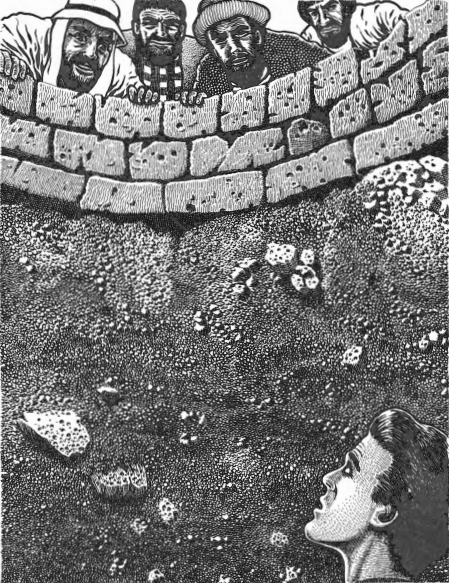
28So when the Midianite traders passed by, his brothers pulled Joseph out of the pit and sold him for twenty shekels of silver to the Ishmaelites, who took him to Egypt.
29When Reuben returned to the pit and saw that Joseph was not there, he tore his clothes, 30returned to his brothers, and said, “The boy is gone! What am I going to do?”
Genesis 37:28–30 Commentary
Joseph’s Betrayal Shadows the Sufferings of Messiah:
This chapter lines up with the Messiah’s story in a way the New Testament picks up again and again. Here in Genesis, Joseph is the father's beloved son (Genesis 37:3), directly foreshadowing Yeshua proclaimed nearly two millennia later at the Jordan as the Father's beloved Son (Matthew 3:17). Joseph is sent by his father to seek out his hostile brothers (Genesis 37:13), just as the heavenly Father would dispatch the Son to His own people in the fullness of time (John 1:11; Matthew 21:37). His brothers hate him without cause (Genesis 37:4–5, 8), anticipating the exact grievance Yeshua voiced during His earthly ministry: they hated Me without cause (John 15:25). They strip Joseph of his distinctive robe (Genesis 37:23), prefiguring Roman soldiers casting lots for Yeshua’s seamless garment at the cross nearly two millennia later (John 19:23–24). Joseph is sold for twenty pieces of silver on Judah’s calculated suggestion (Genesis 37:26–28), directly shadowing Yeshua being betrayed by Judas for thirty pieces of silver in the Gospel account (Matthew 26:14–16).
31Then they took Joseph’s robe, slaughtered a young goat, and dipped the robe in its blood. 32They sent the robe of many colors to their father and said, “We found this. Examine it to see whether it is your son’s robe or not.”
33His father recognized it and said, “It is my son’s robe! A vicious animal has devoured him. Joseph has surely been torn to pieces!” 34Then Jacob tore his clothes, put sackcloth around his waist, and mourned for his son many days. 35All his sons and daughters tried to comfort him, but he refused to be comforted. “No,” he said, “I will go down to Sheol mourning for my son.” So his father wept for him.
Genesis 37:31–35 Commentary
The Deceiver Deceived — Jacob Reaps What He Sowed:
The brothers now engage in a cold-blooded cover-up. Just as Jacob had once deceived his own father with goatskins ten chapters earlier in Genesis 27, the universal harvest law the Apostle Paul would formulate nearly two millennia later in Galatians 6:7 now violently rebounds upon his head through his sons — the third time this law of retribution has played out in this family. Notice the brothers do not even refer to Joseph as “our brother,” but ask Jacob whether this is “your son’s robe,” deliberately distancing themselves from him. Tearing one’s garments and wearing sackcloth were ancient Near Eastern mourning customs, never commanded by God but serving as outward expressions of profound grief.
Jacob’s Grief — Death Pictured as Sleep:
Jacob believes Joseph has died and declares he will go down to Sheol mourning for his son. This reinforces the consistent doctrine of mortality articulated across the Hebrew Scriptures: as King Solomon would observe nearly a thousand years later during the monarchy, the dead are “asleep” and know nothing (Ecclesiastes 9:5, 10), the spirit returns to God who gave it (Ecclesiastes 12:7), and the deceased rests unconscious in the grave awaiting the resurrection, rather than passing into conscious existence apart from the body.
36Meanwhile, the Midianites sold Joseph in Egypt to Potiphar, an officer of Pharaoh and captain of the guard.
Genesis 37:36 Commentary
Joseph’s Ordeal Triggers Abraham’s Prophecy:
Joseph is sold to Potiphar, captain of Pharaoh’s guard. Though the young man suffers real injustice, God has not abandoned him. This human trafficking horror isn’t a random side-quest; it is the exact trigger mechanism fulfilling the macro-prophecy God gave Abraham over two centuries earlier in Genesis 15:13.
Genesis 37:1–4 Commentary
A Bad Report and Favoritism Spark Toxic Jealousy:
Jacob is now dwelling in Hebron, having returned two chapters earlier to his father Isaac at Mamre before Isaac’s death (Genesis 35:27). Favoritism, jealousy, and a family that never deals with its own dysfunction are once again set on a collision course. We are not told what the “bad report” Joseph brought against his brothers actually was, and Scripture gives us no grounds to speculate. Truthful rebuke of real wrongdoing is commanded across the wider biblical canon — Moses would codify over four centuries later at Mount Sinai, “Directly rebuke your neighbor” (Leviticus 19:17), while nearly two millennia down the road the Apostle Paul commands believers in Ephesians 5:11 to expose “the fruitless deeds of darkness.” That is a different thing entirely from malicious slander, and Joseph’s report fits the first category. Jacob loved Rachel more than his other wives, and Joseph was Rachel’s firstborn son — which explains, though never justifies, the blatant favoritism Jacob shows him.
Joseph’s Robe Signals Authority and Inheritance:
The Sunday-school classic “coat of many colors” is a famous mistranslation for an ornate, full-length royal robe. The Hebrew phrase is kethoneth passim, with passim pointing to the palms and soles — describing an ankle-length tunic with full sleeves, in stark contrast to the short, sleeveless work tunics worn by hard laborers in the field. Nearly a thousand years later during the era of the kings, 2 Samuel 13:18 uses this exact technical term for the ceremonial royal robes worn by David’s virgin daughters. Handing this aristocratic garment to a seventeen-year-old boy was Jacob's blatant, public declaration that Joseph held the birthright over all ten older brothers.
Jacob Knew Favoritism’s Cost — and Did It Anyway:
Jacob had watched his own father play favorites between him and Esau, and he knew exactly what bitter division it cost his childhood home. Yet he repeated the identical failure a generation later with his eyes wide open the whole time. Nearly a thousand years later, King Solomon’s proverb would name the danger directly: “who can withstand jealousy?” (Proverbs 27:4). It is the same sin doing the same damage two generations later. Jealousy and envy don’t just poison the man who harbors them; they wreck everyone standing around him too.