Genesis 39
1Meanwhile, Joseph had been taken down to Egypt, where an Egyptian named Potiphar, an officer of Pharaoh and captain of the guard, bought him from the Ishmaelites who had taken him there. 2And YAHWEH was with Joseph, and he became a successful man, serving in the household of his Egyptian master.
3When his master saw that YAHWEH was with him and made him prosper in all he did.
4Joseph found favor in his sight and became his personal attendant. Potiphar put him in charge of his household and entrusted him with everything he owned. 5From the time that he put Joseph in charge of his household and all he owned, YAHWEH blessed the Egyptian’s household on account of him. YAHWEH’s blessing was on everything he owned, both in his house and in his field. 6So Potiphar left all that he owned in Joseph’s care; he did not concern himself with anything except the food he ate.
Now Joseph was well-built and handsome,7and after some time his master’s wife cast her eyes upon Joseph and said, “Sleep with me.”
Genesis 39:4–6 Commentary
The Laban Pattern Repeats in Potiphar’s House:
Joseph is promoted to overseer of the entire household, a position of trust that places every asset Potiphar owns into the hands of a foreign slave. Just as Laban had prospered under Jacob nine chapters earlier in Paddan-aram (Genesis 30:27), those who stand near God’s covenant servants frequently enjoy spillover blessings regardless of their personal merit. Moses specifically notes that Joseph was “well-built and handsome” (Genesis 39:6), deploying the exact Hebrew description previously used ten chapters earlier for his mother Rachel (Genesis 29:17). That detail is not narrative vanity; it is the immediate plot trigger that catches the predatory eye of Potiphar’s wife in verse 7 (Genesis 39:7).
8But he refused. “Look,” he said to his master’s wife, “with me here, my master does not concern himself with anything in his house, and he has entrusted everything he owns to my care. 9No one in this house is greater than I am. He has withheld nothing from me except you, because you are his wife. So how could I do such a great evil and sin against God?”
Genesis 39:7–9 Commentary
Joseph’s Refusal — Sin Is First Against God:
Potiphar's wife propositions him day after day, yet Joseph grounds his resistance on ultimate divine accountability in Genesis 39:9: “So how could I do such a wicked thing and sin against God?” Joseph understood what Israel would not receive in the codified Law for centuries — that sin is first and foremost a direct transgression against the holy Creator Himself.
Sin Was Sin Long Before Mount Sinai:
Pagan king Abimelech recognized this exact principle generations earlier regarding Sarah (Genesis 20:9) and Rebekah (Genesis 26:10), the prophet Malachi over a millennium later declared that God does not change (Malachi 3:6), and nearly two millennia down the road the Apostle John would define sin as lawlessness (1 John 3:4). The Ten Commandments were proclaimed formally at Sinai over four centuries later. Adultery, murder, idolatry, and Sabbath-breaking were sin long before that mountain ever smoked, because God’s character has never needed updating.
10Although Potiphar’s wife spoke to Joseph day after day, he refused to go to bed with her or even be near her. 11One day, however, Joseph went into the house to attend to his work, and not a single household servant was inside. 12She grabbed Joseph by his cloak and said, “Sleep with me!” But leaving his cloak in her hand, he escaped and ran outside.
Genesis 39:10–12 Commentary
Daily Pressure — Temptation Never Knocks Just Once:
Day after day she pressures him, demonstrating how sin seeks to wear down resolve through sheer attrition. Joseph refuses to even remain near her unnecessarily, a practical caution that anticipates the Apostle Paul’s blunt instruction nearly two millennia later to “abstain from every form of evil” (1 Thessalonians 5:22).
Joseph Doesn’t Debate Temptation — He Sprints:
When she finally corners him alone in the house, likely by providence rather than Joseph’s own design, he leaves his garment in her hand and flees outside, living out exactly what the Apostle Paul would command nearly two millennia later in 1 Corinthians 6:18: “Flee from sexual immorality.” Sometimes the godliest response to temptation is not a debate. It is a sprint toward the nearest exit.

13When she saw that he had left his cloak in her hand and had run out of the house, 14she called her household servants. “Look, all of you!” she said, “this Hebrew has been brought to us to make sport of us. He came to me so he could sleep with me, but I screamed as loud as I could. 15When he heard me scream for help, he left his cloak beside me and ran out of the house.”
16So Potiphar’s wife kept Joseph’s cloak beside her until his master came home. 17Then she told him the same story: “The Hebrew slave you brought us came to me to make sport of me, 18but when I screamed for help, he left his cloak beside me and ran out of the house.”
19When his master heard the story his wife told him, saying, “This is what your slave did to me,” he burned with anger. 20So Joseph’s master took him and had him thrown into the prison where the king’s prisoners were confined. While Joseph was there in the prison, 21YAHWEH was with him and extended kindness to him, granting him favor in the eyes of the prison warden. 22And the warden put all the prisoners under Joseph’s care, so that he was responsible for all that was done in the prison.
Genesis 39:13–22 Commentary
Potiphar Commits Joseph to the Royal Prison:
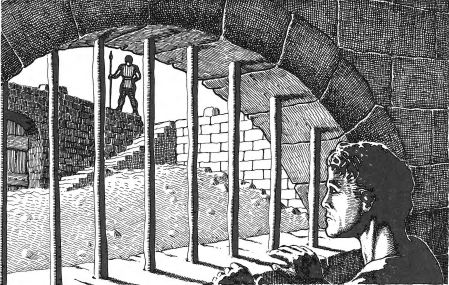
Potiphar’s wife compounds one sin with another. Having failed to seduce Joseph, she falsely frames him for attempted rape — first staging an outrage before the household servants to establish witnesses (Genesis 39:14–15), and then repeating the lie to Potiphar the moment he arrives home. Potiphar is enraged, yet what he does not do is striking. Egyptian law readily permitted execution for a slave accused of violating his master’s wife, yet Potiphar commits him instead to the royal ward where the king’s prisoners were held (Genesis 39:20) — an unexpected leniency suggesting he harbored doubts about his wife’s story, or that Joseph’s years of blameless character bought him mercy an outright slander could not erase.
23The warden did not concern himself with anything under Joseph’s care, because YAHWEH was with Joseph and gave him success in whatever he did.
Genesis 39:21–23 Commentary
God’s Presence — The Anchor Through Every Reversal:
YAHWEH is with Joseph in prison exactly as He was with Joseph in Potiphar’s house, and the keeper of the prison hands him authority over the other prisoners the same way Potiphar once handed him the household. Circumstances kept shifting around Joseph — slave, overseer, falsely accused, prisoner — yet the presence of the Almighty never wavered. That is the whole argument of this chapter, stated once at the top and proven twice by the end. Long trials are not proof of abandonment.
Genesis 39:1–3 Commentary
Potiphar Unwittingly Welcomes God’s Covenant Favor:
Joseph arrives in Egypt as foreign merchandise, purchased by Potiphar, an officer of Pharaoh and captain of the guard — resuming the narrative thread left off two chapters earlier (Genesis 37:36; 39:1). On paper, Joseph is an enslaved teenager stripped of family, status, and freedom. But outward circumstances cannot touch what the Almighty has determined to bless, and Potiphar has no clue that the young Hebrew servant he just acquired carries the covenant favor of the living God under his roof.
“YAHWEH Was With Joseph” — A Fourfold Drumbeat:
Repeated across verses 2, 3, 21, and 23 (Genesis 39:2, 3, 21, 23), this phrase is the theological heartbeat of Genesis 39, not mere literary decoration. Joseph was seventeen years old when his brothers threw him into a pit two chapters earlier (Genesis 37:2), and his ordeal is only beginning, yet the text insists, again and again, that God’s presence was never measured by Joseph’s circumstances. Potiphar notices it too — an Egyptian pagan recognizing that whatever this Hebrew slave’s God is doing, it is prospering everything Joseph touches.