Genesis 7
1Then YAHWEH said to Noah: “Go into the ark, you and all your family, because I have found you righteous in this generation. 2You are to take with you seven pairs of every kind of clean animal, a male and its mate; a pair of every kind of unclean animal, a male and its mate; 3and seven pairs of every kind of bird of the air, male and female, to preserve their offspring on the face of all the earth.
4For seven days from now I will send rain on the earth for forty days and forty nights, and I will wipe from the face of the earth every living thing I have made.”
5And Noah did all that YAHWEH had commanded him.
6Now Noah was 600 years old when the floodwaters came upon the earth. 7And Noah and his wife, with his sons and their wives, entered the ark to escape the waters of the flood.
Genesis 7:5–7 Commentary
Only Eight Survive — The Small Remnant Pattern:
Those eight who entered the Ark foreshadow the Messiah's solemn warning millennia later in Matthew 7:13–14: “small is the gate and narrow the way that leads to life, and only a few find it.” Eight souls were saved out of a world teeming with millions. The crowd was on the other side of that door, partying, mocking, and ignoring the warning until the water was at their chins. Popularity has never been a reliable metric for truth.
8The clean and unclean animals, the birds, and everything that crawls along the ground 9came to Noah to enter the ark, two by two, male and female, as God had commanded Noah.
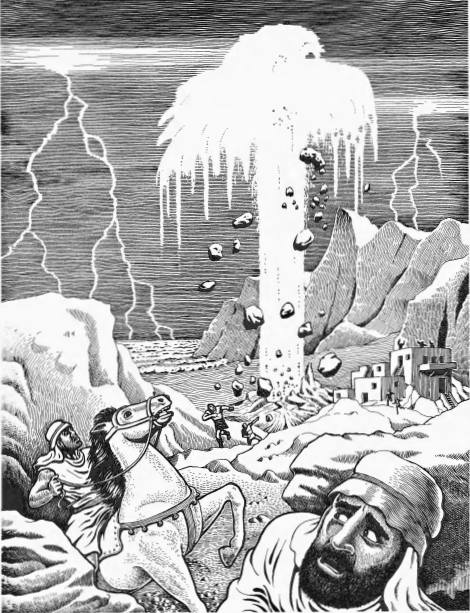
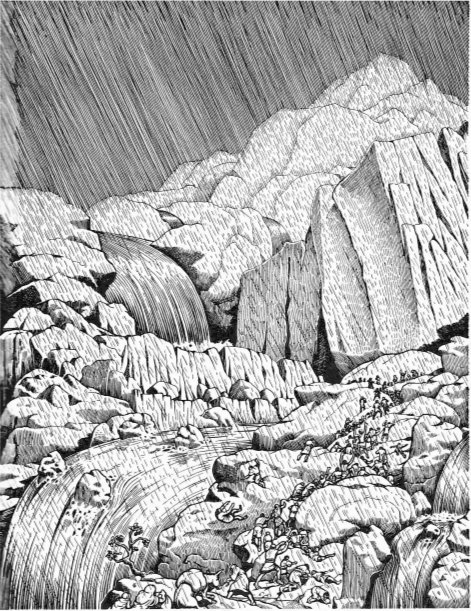
10And after seven days the floodwaters came upon the earth. 11In the six hundredth year of Noah’s life, on the seventeenth day of the second month, all the fountains of the great deep burst forth, and the floodgates of the heavens were opened. 12And the rain fell upon the earth for forty days and forty nights.
Genesis 7:11–12 Commentary
Calling This “Rain” Undersells the Cataclysm:
When the deluge finally comes, two separate sources of water are unleashed at once, and the timing lines up with a precision that should stop anyone from waving this off as myth.
No Ancient Writer Could Guess Deep-Earth Fountains:
Ancient people had no natural scientific means of knowing that subterranean water reserves could burst open apart from divine revelation. Yet Genesis 7:11 explicitly distinguishes two separate catastrophic sources: "on that day all the fountains of the great deep burst forth, and the windows of the heavens were opened." These two mechanisms are described independently of ordinary rainfall, confirming a cataclysmic geological and atmospheric event.
A 2014 Discovery Confirms Deep-Earth Oceans:
In 2014, scientists made a stunning discovery: there is a colossal ocean of water trapped hundreds of miles down inside the Earth’s mantle. Inside a mineral called ringwoodite — found locked inside a diamond from deep underground — researchers found water trapped right inside the rock’s molecular structure. If that layer holds as much moisture as scientists estimate, it contains as much water as all of our surface oceans combined!
Tectonic Rifting Blasted Subterranean Oceans Upward:
But how could all that water ever reach the surface? As shifting tectonic plates grind against each other, intense heat and pressure cause the mineral to 'sweat out' its water. Under that kind of volcanic heat, the Earth becomes a massive pressure cooker. When the ocean floor cracked open — ripping the crust wide open like a giant zipper — that pressurized subterranean reservoir blasted upward with explosive force. Science has finally caught up with what Moses recorded thousands of years ago in Genesis 7:11: "on that day all the fountains of the great deep burst forth."
Methuselah’s Own Name Points to This Exact Year:
The divine timing is just as pointed as the physical mechanism. The Flood struck exactly in the six-hundredth year of Noah’s life. If you calculate the chronological timelines recorded back in the genealogy of Genesis 5, this is the exact year Methuselah died. His Hebrew name literally means "when he dies, it shall be sent" (or "his death shall bring") — matching the Creator’s timetable to the exact year.
Forty Days — God’s Pattern of Judgment and Testing:
Rain falls for forty days and forty nights, establishing a divine pattern that echoes down across millennia of biblical history whenever judgment, testing, or probation appears: nearly a thousand years later Moses fasts forty days on Mount Sinai (Exodus 34:28) and Israel wanders forty years in the wilderness (Numbers 14:34), centuries later the prophet Jonah gives Nineveh forty days to repent (Jonah 3:4), and more than two millennia later in the Gospels, Yeshua is tempted forty days in the Judean wilderness (Matthew 4:1–2). That kind of repetition is not a coincidence.
13On that very day Noah entered the ark, along with his sons Shem, Ham, and Japheth, and his wife, and the three wives of his sons— 14they and every kind of wild animal, livestock, crawling creature, bird, and winged creature. 15They came to Noah to enter the ark, two by two of every creature with the breath of life. 16And they entered, the male and female of every living thing, as God had commanded Noah. Then YAHWEH shut him in.
Genesis 7:13–16 Commentary
Japheth Is Listed Last Among the Three Sons:
Japheth appears to be the youngest of Noah’s sons in the list given here (Shem, Ham, Japheth), confirming that Ham was the middle brother — a crucial detail when identifying who Noah’s “youngest son” was two chapters later in Genesis 9:24.
God Shuts the Door — Noah Has No Rudder:
Once everyone and everything is aboard, God Himself shuts Noah inside the Ark, admitting no one else. The vessel had no rudder or steering mechanism of any kind; survival depended entirely on trusting God to guide and protect them through the Flood.
17For forty days the flood kept coming on the earth, and the waters rose and lifted the ark high above the earth. 18So the waters continued to surge and rise greatly on the earth, and the ark floated on the surface of the waters. 19Finally, the waters completely prevailed upon the earth, so that all the high mountains under all the heavens were covered.
20The waters rose and covered the mountaintops to a depth of fifteen cubits.
Genesis 7:20 Commentary
Fifteen Cubits Above Peaks — The Ark’s Draft:
The waters rise fifteen cubits (about twenty-two feet) above the highest mountain peaks. That specific depth isn’t random: a vessel the size of the Ark, loaded to capacity, draws roughly fifteen cubits of water. The depth ensured the hull cleared every submerged summit on earth without running aground.
The Long, Grinding Wait to Dry Out:
The Flood has done its destructive work, and Noah’s patience gets tested here for the better part of a year as the waters slowly recede.
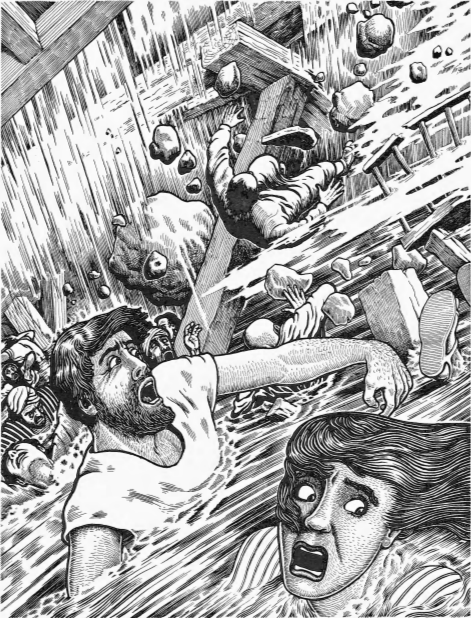
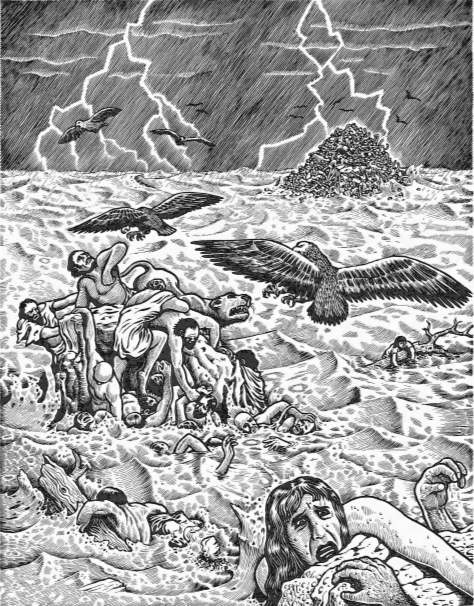
21And every living thing that moved upon the earth perished—birds, livestock, animals, every creature that swarms upon the earth, and all mankind. 22Of all that was on dry land, everything that had the breath of life in its nostrils died. 23And every living thing on the face of the earth was destroyed—man and livestock, crawling creatures and birds of the air; they were blotted out from the earth, and only Noah and those with him in the ark remained.
24And the waters prevailed upon the earth for 150 days.
Genesis 7:1–4 Commentary
Noah Knew Clean From Unclean Long Before Sinai:
Nearly a thousand years later at Mount Sinai, this distinction between clean and unclean animals is fully codified in the Torah in Leviticus 11:1–47, and called an abomination when ignored in Deuteronomy 14:2–3. These laws serve both a ceremonial and a practical purpose, setting God’s people apart in more ways than one.
Seven Pairs Echo God’s Number of Completion:
Preserving seven pairs each of clean animals and birds reflects a divine pattern visible throughout Scripture: the seven-day Creation week, the weekly Sabbath, the Jubilee cycle, and, as Moses would codify nearly a millennium later at Mount Sinai, the fifty-day count to Pentecost (Shavuot) — one of God’s official Appointed Times (mo’adim) commanded in the Law (Leviticus 23).
A Practical Reason Sits Behind the Surplus:
As our upcoming chapters will reveal, Noah needed those extra clean animals for immediate worship sacrifices upon disembarking (Genesis 8:20), as well as for food once God formally permitted the consumption of clean meat in the post-Flood era (Genesis 9:3). Furthermore, it reflects sound ecological design: a balanced ecosystem requires far more herbivorous prey than predators. If Noah had only brought a single pair of sheep, a predator would have driven the species to instant extinction before lunch.