Genesis 12
1Then YAHWEH said to Abram: “Leave your country, your kindred, and your father’s household, and go to the land I will show you.
2I will make you into a great nation, and I will bless you; I will make your name great, so that you will be a blessing.
3I will bless those who bless you and curse those who curse you; and all the families of the earth will be blessed through you.”
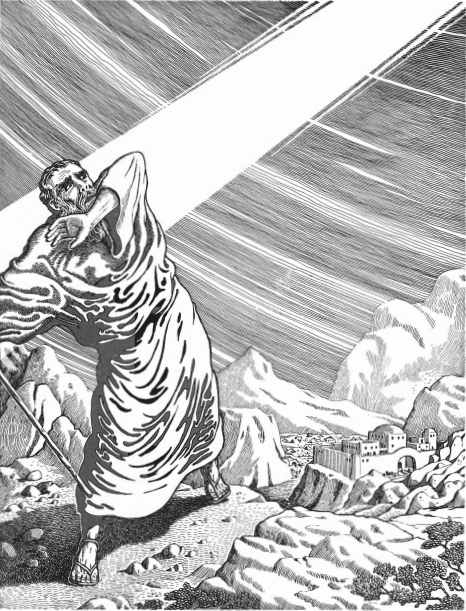
4So Abram departed, as YAHWEH had directed him, and Lot went with him. Abram was seventy-five years old when he left Haran.
Genesis 12:4 Commentary
Abram Obeys YAHWEH — Faith That Moves Feet:
Two millennia later, the Apostle James would land the point that belongs right here: “faith without deeds is dead” (James 2:26). Abram believes in a promise, packs up an entire household, and walks toward a land he can’t even name yet. That’s what real faith looks like every single time Scripture describes it — belief that moves the feet, not belief that stays comfortably seated in the pew.
Abram Called at Seventy-Five — Never Too Late:
At seventy-five years of age, Abram receives the divine call to leave everything behind. It is never too late in a man’s life to start walking with the Almighty.
5And Abram took his wife Sarai, his nephew Lot, and all the possessions and people they had acquired in Haran, and set out for the land of Canaan. When they came to the land of Canaan, 6Abram traveled through the land as far as the site of the Oak of Moreh at Shechem. (At that time the Canaanites were in the land.)
7Then YAHWEH appeared to Abram and said, “I will give this land to your offspring.” So Abram built an altar there to YAHWEH, who had appeared to him.
Genesis 12:5 Commentary
He Went, Not Knowing Where:
Abram takes his wife Sarai and his nephew Lot and sets out into the unknown. Millennia down the corridor of biblical history, the Hall of Faith in Hebrews 11:8 nails the character of Abram’s departure precisely: “he went out, not knowing where he was going.”
Abram’s Servants Were Protected by Covenant:
Abram is already a wealthy man by this point, with a large household that includes many servants. Here’s the legal reality: this servant structure was regulated, protective, and bound by covenant obligation, standing completely apart from the chattel slavery of later centuries...
Genesis 12:6–7 Commentary
Wherever God Appears, Abram Builds an Altar:
Abram passes through Shechem, in the central hill country of what will one day become the land of Israel, and there YAHWEH appears to him and promises this exact land to his offspring. Abram responds by building an altar on the spot to worship Him directly. No middleman required.
The Land Promise Operates on a Separate Timeline:
This territorial covenant is legally distinct from the global blessing in Genesis 12:1–3. They operate on separate prophetic tracks before ultimately merging when Yeshua establishes the global Kingdom of God after His return.
8From there Abram moved on to the hill country east of Bethel and pitched his tent, with Bethel to the west and Ai to the east. There he built an altar to YAHWEH, and he called on the name of YAHWEH.
9And Abram journeyed on toward the Negev.
Genesis 12:8 Commentary
Abram Calls on God Wherever He Stands:
Abram moves on toward Bethel, pitches his tent between Bethel and Ai, builds a second altar, and personally calls on the name of YAHWEH. This establishes the pattern of his entire life: an intimate walk with the Almighty, maintained wherever he pitched his tent.
10Now there was a famine in the land. So Abram went down to Egypt to live there for a while because the famine was severe. 11As he was about to enter Egypt, he said to his wife Sarai, “Look, I know that you are a beautiful woman, 12and when the Egyptians see you, they will say, ‘This is his wife.’ Then they will kill me but will let you live. 13Please say you are my sister, so that I will be treated well for your sake, and on account of you my life will be spared.”
Genesis 12:10–13 Commentary
The Father of the Faithful Panics in Egypt:
Abram is about to walk into Egypt scared out of his mind, and the first thing he does is sacrifice his own wife’s safety to save his own skin.
The First of Three “She Is My Sister” Episodes:
Famine drives Abram down into Egypt, a land descended from Ham through his son Mizraim, cataloged two chapters earlier in Genesis 10:6. In upcoming chapters, Genesis 20:1–18 and Genesis 26:6–11 will show the exact same vulnerability repeating in Abraham and Isaac. Confronted with famine, the patriarch falters in faith, resorting to a half-truth that exposes his wife to immense danger.
A Half-Truth Deployed to Deceive Is Still a Lie:
Abram, terrified that the Egyptians will murder him to seize Sarai, instructs her to say she is his sister rather than his wife. While technically true because Sarai was his half-sister, this calculated maneuver was designed to deceive. In Genesis 12:13, Abram asks her to do this "that it may go well with me... and that my life may be spared for your sake" — language built entirely around his own nephesh (physical survival) at his wife’s severe peril.
14So when Abram entered Egypt, the Egyptians saw that the woman was very beautiful. 15When Pharaoh’s officials saw Sarai, they commended her to him, and she was taken into the palace of Pharaoh. 16He treated Abram well on her account, and Abram acquired sheep and cattle, male and female donkeys, menservants and maidservants, and camels.
17YAHWEH, however, afflicted Pharaoh and his household with severe plagues because of Abram’s wife Sarai. 18So Pharaoh summoned Abram and asked, “What have you done to me? Why didn’t you tell me she was your wife? 19Why did you say, ‘She is my sister,’ so that I took her as my wife? Now then, here is your wife. Take her and go!”
20Then Pharaoh gave his men orders concerning Abram, and they sent him away with his wife and all his possessions.
Genesis 12:15–20 Commentary
‘Pharaoh’ Is a Dynastic Title, Not a Name:
Pharaoh takes Sarai into his royal house — the same dynastic title that later confronts Moses in Exodus. God intervenes with plagues on Pharaoh’s household, and when the monarch discovers the deception, his rebuke lands with biting force in Genesis 12:18: “What have you done to me? Why didn’t you tell me she was your wife?”
A Pagan King Ends Up on Better Moral Ground:
Look at who’s standing on the moral high ground in this exchange. Pharaoh, a pagan king with no covenant and no Law written down anywhere yet, acted immediately to avoid adultery once he discovered the truth, a sin the Seventh Commandment will codify over six centuries later at Mount Sinai: “You shall not commit adultery” (Exodus 20:14). Abram, the man God had personally called and covenanted with, acted through deceit, violating principles the Ninth Commandment will codify at Sinai against bearing false witness: “You shall not bear false witness against your neighbor” (Exodus 20:16). The father of the faithful does not walk out of this episode looking faithful, and Scripture puts the failure on the page in plain ink. This book has no interest in polishing its own heroes.
Abram’s Trip to Egypt Is a Preview of the Exodus:
Lay this story over the future book of Exodus and the outline is remarkably identical. A famine drives the family down to Egypt (Genesis 12:10). Pharaoh takes what belongs to YAHWEH’s people, and YAHWEH strikes Pharaoh and his house with great plagues (Genesis 12:17). Pharaoh sends them out, and they leave with great wealth (Genesis 12:20; 13:2). That is the exact sequence Israel experiences over six centuries later: famine, Egypt, plagues, release, plunder (Exodus 12:35–36). YAHWEH was rehearsing the Exodus with the father of the nation, and He would tell Abram how it would unfold three chapters ahead in the covenant vision (Genesis 15:13–14).
Genesis 12:1–3 Commentary
No Nation, No Temple — Just One Obedient Faith:
God calls Abram out of Ur of the Chaldeans, away from his country, his people, and his father’s household, toward a land God will show him but hasn’t named yet. There is no written Law at Sinai yet, but God’s righteous standards are already active — as an upcoming chapter in Genesis 26:5 will prove when God declares Abraham kept His commandments and laws. What God calls here is active, obedient faith stepping out into the unknown. Millennia later under the New Covenant, the Apostle Paul would call Abram “the father of us all who share the faith of Abraham” (Romans 4:16), and his point cuts straight to the bone: the man who fathers the entire covenant story is an idolater’s son responding in faithful obedience to a voice.
Stephen Confirms Abram’s Call Began in Ur of the Chaldeans:
Genesis 12:1 reads in isolation like Abram’s call originated in Haran, but Stephen’s inspired defense before the Sanhedrin confirms that the divine call began much earlier. Over two millennia later, Stephen's inspired defense in Acts 7:2–4 explicitly confirms: “The God of glory appeared to our father Abraham while he was still in Mesopotamia, before he lived in Haran, and said to him, ‘Leave your country and your relatives, and go to the land that I will show you.’” This means the initial supernatural summons took place back in Ur of the Chaldeans, motivating Terah’s clan to pack up and set out for Canaan as recorded in our previous chapter (Genesis 11:31). When Terah stalled out and settled in Haran until his death, Genesis 12:1 represents YAHWEH renewing and pressing the original commission: “Now YAHWEH had said to Abram, ‘Get out of your country...’”
“The God of Glory” — The Pre-Incarnate Word Appeared to Abram:
Notice as well the title Stephen uses: the One who appeared and spoke in Ur was “the God of glory” — the visible YAHWEH, the pre-incarnate Word, who continually appears to Abram throughout his pilgrimage.
God’s Blessing Reaches Past Abram’s Bloodline:
Millennia later, Galatians 3:8 quotes this foundational promise — “In you all the families of the earth shall be blessed” — and states plainly that God preached the gospel beforehand to Abraham in these words: “In you shall all the nations be blessed.” Through Abraham’s Seed — Yeshua the Messiah specifically — comes the Savior and redemption of all humanity. The entire missionary scope of the New Testament sits coiled up inside one verse, thousands of years before Yeshua ever walks the earth.
The Covenant’s Dual Track — Nation and Messiah:
God’s promise carries a physical birthright of national greatness alongside a spiritual scepter line leading to the Messiah. It’s the direct continuation of the Seed promise first introduced back in Genesis 3:15. Through Abraham’s physical offspring, the nations would receive the written Word of God, the covenant promises, and ultimately the Savior who conquers the serpent.
God Reverses Babel — “I Will Make Your Name Great”:
Put Babel from our previous chapter in Genesis 11:4 alongside Abram here in Genesis 12:2. At Babel, rebellious mankind said, “let us make a name for ourselves.” Here in Genesis 12, God says to Abram, “I will make your name great.” Man’s self-exaltation ends in scattering and disgrace; God’s sovereign blessing produces enduring greatness. You cannot build a name that lasts through cosmic mutiny; real greatness is given by YAHWEH to those who walk in humble obedience.