Genesis 2
1Thus the heavens and the earth were completed in all their vast array. 2And by the seventh day God had finished the work He had been doing; so on that day He rested from all His work.
3Then God blessed the seventh day and made it holy, because on that day He rested from all the work of creation that He had accomplished.
4This is the account of the heavens and the earth when they were created,
in the day that YAHWEH
God made them.
Genesis 2:4 Commentary
“Toledot” — Moses May Have Used an Older Record:
“Generations” in Hebrew is toledot, and this word can also mean “history” or “account” — a possible marker that Moses was drawing from an ancient family document or oral genealogy rather than composing from scratch. That is a hypothesis some scholars hold, not something the text states outright.
5Now no shrub of the field had yet appeared on the earth, nor had any plant of the field sprouted, for YAHWEH God had not yet sent rain upon the earth, and there was no man to cultivate the ground. 6But springs welled up from the earth and watered the whole surface of the ground.
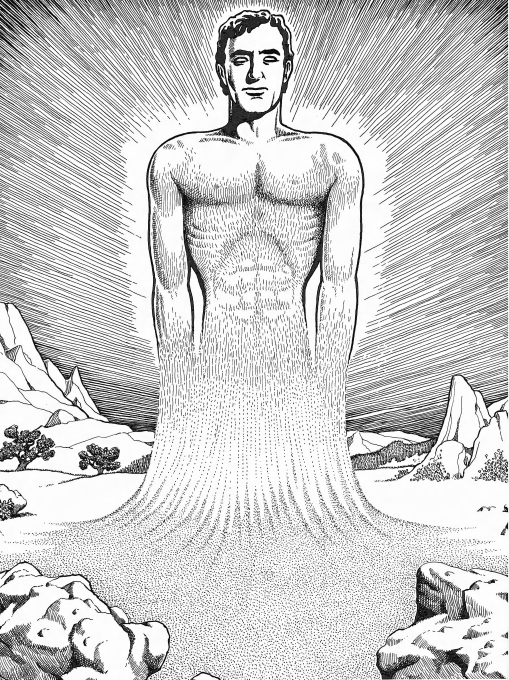
7Then YAHWEH God formed man from the dust of the ground and breathed the breath of life into his nostrils, and the man became a living soul.
Genesis 2:5–7 Commentary
A World Watered by Mist, Not Rain:
These verses drop a detail modern readers easily overlook: rain had not yet fallen on the earth. A subterranean mist watered the ground instead, and rain never appears in the text again until the heavens burst open at the Flood. The hydrological system of the early earth was entirely different, and Moses flags that reality long before Noah enters the scene.
Formed by Hand, Breathed Into by God:
Look at the intimate physics of how Adam is brought to life. The animals come out of the ground too — as recorded earlier in Genesis 1:24, God commanded the earth to bring them forth, and as we will see shortly in Genesis 2:19, YAHWEH God “formed” every beast of the field out of the ground — so the clay isn’t what sets Adam apart. What happens next is. The Hebrew text says God “formed” the man (yatzar — like a potter personally shaping clay with His hands) and then “breathed” into his nostrils. That word for breathed, naphach, simply means to breathe or blow, and the text never pictures God doing that for the animals. This is God, up close, putting His own breath into the man He just shaped.
Man and Animals Share the Same “Soul”:
While many modern English Bibles translate this phrase as "a living being" or "living creature," the literal Hebrew text (nephesh chayyah) states that Adam became "a living soul" — the exact term used for marine and land animals back in our account in Genesis 1:20, 24, and quoted millennia later by Paul in 1 Corinthians 15:45. That word choice does real theological work. Humans and animals alike are souls; we don’t carry some separate, indestructible soul tucked inside us. Adam is formed from dust and will return to dust — mortal by nature, not possessing an inherent immortal soul.
The Breath of Life Gave Adam a Mind:
That overlap with the animals only tells half the story, though. Genesis 2:7 doesn’t just say God breathed into Adam — it says He breathed “the breath of life,” nishmat chayim in the Hebrew, into his nostrils specifically. That breath is what the Apostle Paul would millennia later identify in 1 Corinthians 2:11 as “his own spirit within him” — not a separate creature living inside Adam, but the component that combines with a physical brain to produce an actual functioning mind: thought, reasoning, self-awareness, the capacity to create.
Nebuchadnezzar Proved the Mind Requires the Human Spirit:
Take that spirit away, and the brain doesn’t produce a diminished mind. It produces something closer to an animal. Thousands of years later during the Babylonian exile, Nebuchadnezzar found that out the hard way, driven out to eat grass like cattle until he acknowledged that “the Most High rules over the kingdom of mankind” (Daniel 4:25, 32) — a king who temporarily lost the spirit of man and lost his mind right along with it.
Ecclesiastes Contrasts Human Spirit with Animal Instinct:
Three millennia later in the wisdom literature, King Solomon draws the same line from a different angle in Ecclesiastes 3:19–21. Physically, humans and animals share the same fate — both come from the dust, and both return to it. But Solomon asks pointedly who really tracks “if the spirit of man rises upward and the spirit of the animal descends into the earth.” Animals were given life and instinct; man alone was given a spirit that returns to God rather than simply ceasing.
The Human Spirit Preserves Your Unique Identity:
This spirit is not an apparition awake and conscious after death. Think of it like a hard drive: it holds the specific memory and personality of the one who died, safe with God until the resurrection reassembles the whole person, exactly as Solomon would articulate millennia later in Ecclesiastes 12:7: “the dust returns to the ground from which it came and the spirit returns to God who gave it.” Adam is never told he owns a soul that cannot die. He’s told the opposite — what God gives him here is built to survive his death, not to keep him conscious through it.
Mortal Did Not Mean Doomed:
Continual access to the Tree of Life, noted in Genesis 2:9, stood ready to sustain Adam indefinitely. Death was a natural possibility built into his makeup from the start, but not a natural inevitability — that would depend on whether he stayed in the garden and in obedience.
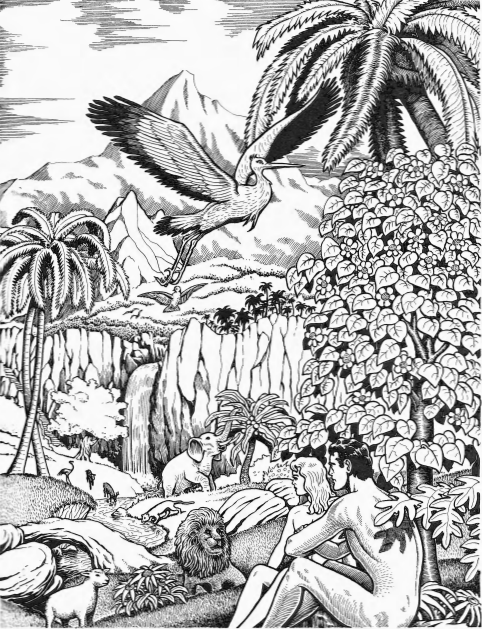
8And YAHWEH God planted a garden in Eden, in the east, where He placed the man He had formed. 9Out of the ground YAHWEH God gave growth to every tree that is pleasing to the eye and good for food. And in the middle of the garden were the tree of life and the tree of the knowledge of good and evil.
Genesis 2:9 Commentary
Eden’s Two Trees — Literal and Loaded With Meaning:
The choice in the garden couldn't be starker: the Tree of Life represents eternal life flowing directly from God; the Tree of the Knowledge of Good and Evil represents man declaring moral autonomy — deciding right and wrong on his own terms apart from his Creator. That second path leads, every single time, straight to ruin and death.
10Now a river flowed out of Eden to water the garden, and from there it branched into four headwaters:
11The name of the first river is the Pishon; it winds through the whole land of Havilah, where there is gold. 12And the gold of that land is pure, and bdellium and onyx are found there.
13The name of the second river is the Gihon; it winds through the whole land of Cush.
14The name of the third river is the Tigris; it runs along the east side of Assyria. And the fourth river is the Euphrates.
Genesis 2:10–14 Commentary
Eden Rooted in Real Geography, Not Myth:
Moses isn't spinning an imaginary myth; he anchors Eden with verifiable ancient geography: Havilah points to the Arabian peninsula; Cush to ancient Ethiopia; Assyria to northern Iraq. These historical coordinates firmly situate the cradle of humanity in the Fertile Crescent, near ancient Mesopotamia.
15Then YAHWEH God took the man and placed him in the Garden of Eden to cultivate and keep it.
16And YAHWEH God commanded him: “You may eat freely from every tree of the garden, 17but you must not eat from the tree of the knowledge of good and evil; for in the day that you eat of it: You will surely die.”
Genesis 2:15–17 Commentary
Adam’s Mandate — Work and Keep the Garden:
God's command in Genesis 2:15 "to cultivate and keep it" establishes human stewardship from the very beginning. Caring well for what God has made is how we honor the Creator — that means neither exploiting the earth nor neglecting it.
“Work and Keep” — Priestly Sanctuary Duties in Eden:
Don’t picture Adam merely as an ordinary gardener with a hoe. “Work” and “keep” are the Hebrew words Avad (to serve, to work) and Shamar (to guard, to keep), the exact paired terms God would assign over two millennia later at Mount Sinai for the Levites’ priestly duties in the sanctuary (Numbers 3:7–8; 18:5–6). That’s no accident. Thousands of years later, the prophet Ezekiel confirms this sanctuary imagery, calling Eden “the garden of God” and setting it on “the holy mountain of God,” complete with an anointed guardian cherub (Ezekiel 28:13–14). The garden was a sanctuary — God’s own mountain dwelling, with Adam as its first caretaker and guard.
God Walking in Eden Foretells His Tabernacle Presence:
The pieces keep stacking. In our upcoming chapter, YAHWEH is pictured “walking” in the garden (Genesis 3:8), using the Hebrew verb hithalek—the identical word He would use centuries later at Sinai when promising to dwell in the Tabernacle among His people: “I will walk among you” (Leviticus 26:12). And as we will read at the climax of the next chapter, when Adam is expelled, cherubim are posted at the eastern entrance (Genesis 3:24) like sentinels guarding a temple door. Eden was God’s mountain first. Hold on to that, because the Bible keeps coming back to God’s mountain, and eventually to a rival one that wants it.
“Surely Die” Means Real Death, Not Eternal Torment:
The divine warning points to actual cessation of life, not immortal suffering in hellfire. Once humanity claimed the right to define good and evil for itself, war, famine, suffering, corruption, and physical death followed, along with a strange human capacity for both extraordinary good and terrible evil.
Eden’s Warning Points to the “Second Death”:
Looking all the way to the apocalyptic climax of Scripture, the sentence pronounced in Eden echoes into Revelation 20:14 — the final, permanent death waiting for the unrepentant after resurrection and judgment, as opposed to the ordinary first death everyone faces. It also points forward to the very end of the Bible, where the Tree of Life reappears in Revelation 22:2, 14, growing inside the New Jerusalem, its leaves “for the healing of the nations,” its fruit finally open again to “those who wash their robes” — available at last to the redeemed.
18YAHWEH God also said, “It is not good for the man to be alone. I will make for him a suitable helper.”
19And out of the ground YAHWEH God formed every beast of the field and every bird of the air, and He brought them to the man to see what he would name each one. And whatever the man called each living creature, that was its name. 20The man gave names to all the livestock, to the birds of the air, and to every beast of the field. But for Adam no suitable helper was found.
21So YAHWEH God caused the man to fall into a deep sleep, and while he slept, He took part of the man’s side and closed up the area with flesh. 22And from the side that YAHWEH God had taken from the man, He made a woman and brought her to him.
Genesis 2:18–22 Commentary
Hebrew “Ezer” — A Title Used of God:
“It is not good that man should be alone,” so man and woman are made to complete one another. What English translates as “helper” is Ezer, carrying zero hint of inferiority. Millennia later in Israel's history, Scripture uses this exact same word of God Himself coming to the rescue of His people — as Moses testifies in Exodus 18:4, “The God of my father was my helper,” and David cries in Psalm 70:5, “You are my help and my deliverer; O YAHWEH, do not delay” If Ezer were a demeaning term, Scripture would never apply it to the Almighty. Man and woman stand spiritually equal before God, even with different roles.
Naming the Animals Established Legal Authority:
Adam then names every animal and finds no match among them. This animal-naming protocol wasn’t just a vocabulary exercise; it established a legal reality. Throughout the rest of Scripture, the act of bestowing a name consistently indicates leadership over the thing named — just like God naming Adam, or later, Pharaoh renaming Joseph, and Yeshua naming Peter. By naming the animals, Adam’s leadership over creation was locked in.
Built From Adam’s Side, Not the Dust:
With the search exhausted and no match found, God moves. He causes a deep sleep to fall on Adam, the same kind of sleep Abram will fall into chapters later during the covenant ceremony in Genesis 15:12. Woman is completely unique within the whole creation account: while Adam and the beasts came from raw ground, she was fashioned directly from living bone and flesh.
Architectural "Side" (Tsela) Pictures Marital Oneness:
While traditional English translations render the Hebrew word tzela as "rib," everywhere else in the Old Testament it designates an architectural "side" (such as the side of the Tabernacle or Ark of the Covenant). God did not merely extract an isolated bone; He took part of the man’s side — bone and flesh together — and fashioned the woman from it. By building her from his actual side, the Creator established that man and woman share the exact same physical essence, serving as a timeless picture of marital oneness. As the classic commentary by Matthew Henry famously observed: "Woman was not taken from man’s head, to rule over him, nor from his foot, to be crushed by him, but from under his arm, to be protected, and from near his heart, to be loved."
23And the man said:
“This is now bone of my bones
and flesh of my flesh;
she shall be called ‘woman,’
for out of man she was taken.”
24For this reason a man will leave his father and mother and be united to his wife, and they will become one flesh.
25And the man and his wife were both naked, and they were not ashamed.
Genesis 2:23–24 Commentary
Marriage Is a Divine, Not Human, Institution:
ish and ishah, man and woman in Hebrew, share a name because they share an origin, a connection the Hebrew makes audible in a way English can’t capture. The Creator joins one man and one woman covenantally, spiritually, and physically into “one flesh,” setting the permanent pattern for all human history.
Genesis 2:1–3 Commentary
The Heavenly Host Was Created Too:
Verse 1 (Genesis 2:1) wraps up creation with a phrase most English Bibles flatten. “All their vast array” translates the Hebrew word tzaba, meaning “host” — an organized army. When Scripture says “host of heaven,” this is the word, and it covers the stars as well as the spirit beings seen thousands of years later standing before YAHWEH’s throne in the prophet Micaiah’s vision (1 Kings 22:19). Moses is telling you the heavens and the earth were finished with their whole host in place, and every member of it is part of the completed work. Nothing in the unseen realm stands outside what God made.
The Sabbath Predates Israel by Millennia:
The seventh day makes its holy appearance here at creation, before Israel exists, before Moses, before the word “Jew” means anything at all. God “rested” on the seventh day, not because He was tired — as the prophet Isaiah would remind Israel thousands of years later, “YAHWEH is the everlasting God… He will not grow tired or weary” (Isaiah 40:28). He rested as an example for us to follow. The Hebrew word behind “rested” is shabbat, the verb form of “Sabbath” itself, meaning to cease or rest from labor. He then blessed the seventh day and made it holy, language used of no other day anywhere in Scripture.
The Sabbath Was Made for All Mankind:
The Sabbath was holy before there was a nation of Israel to keep it, and it remains holy because God made it holy. Millennia later in the Gospels, Yeshua settles the matter in Mark 2:27–28: “The Sabbath was made for man” — all humanity, not one people alone — and the Son of Man is Lord of it.
Genesis 1 and 2 Aren’t Rival Accounts:
That’s Day Seven settled — and it’s worth pausing here before Genesis 2 doubles back and does something that trips up a lot of readers. Critics love claiming the two chapters contradict each other, but they don’t. Recall from earlier in our account that Genesis 1 was the panoramic, satellite overview of the entire creation week. Genesis 2 is a ground-level zoom lens pulling focus entirely on the events of Day Six.