Genesis 3
1Now the serpent was more crafty than any beast of the field that YAHWEH God had made. And
he said to the woman, “Did God really say, ‘You must not eat from any tree in the garden?’”
2The woman answered the serpent, “We may eat the fruit of the trees of the garden, 3but about the fruit of the tree in the middle of the garden, God has said, ‘Neither of you may eat of it or touch it, or you both will die.’”
4“You will surely not die, either of you!” the serpent told the woman. 5“For God knows that in the day both of you eat of it, your eyes will be opened, and you will be like God, knowing good and evil.”
6When the woman saw that the tree was good for food and pleasing to the eyes, and that it was desirable for obtaining wisdom, she took the fruit and ate it. She also gave some to her husband who was with her, and he ate it.
7And the eyes of both of them were opened, and they knew that they were naked; so they sewed together fig leaves and made coverings for themselves.
8Then the man and his wife heard the voice of YAHWEH God walking in the garden in the breeze of the day, and they hid themselves from the presence of YAHWEH God among the trees of the garden.
Genesis 3:4–7 Commentary
The First Recorded Lie in All Scripture:
The serpent's lie in Genesis 3:4, “You will surely not die, either of you!” was the original deception — a flat, brazen contradiction of the Creator's explicit warning given back in Genesis 2:17.
Their Eyes Opened — A Lie Mixed With Truth:
Adam and Eve’s eyes really were opened once they ate, and that detail matters. Satan’s deceptions rarely come as pure fiction; he mixes in just enough truth to make the poison believable, and that is exactly what makes him dangerous. What Adam and Eve reached for was the authority to decide good and evil for themselves. Not new information. A claim to authority.
“Like God” — Grabbing for a Seat Among Elohim:
Look closely at verse 5 (Genesis 3:5). “You will be like God,” the serpent says — and the Hebrew word for “God” there is Elohim, the category word for divine beings that Scripture uses of YAHWEH and of other spirit beings alike. He wasn’t selling a snack. He was selling a promotion. A seat among the Elohim was on the table, and Adam and Eve grabbed for it the fast way.
Satan’s Shortcut vs. God’s Gift of Family Adoption:
The tragedy is that God already had the same destination planned for them as a gift. Millennia after Eden, the Apostle Paul would explain in Romans 8:29 that believers are predestined to be “conformed to the image of His Son,” brought into the family as adopted sons. Satan offered a shortcut to something God was going to hand over for free — and it is the exact same play he would run on Yeshua in the Judean wilderness (Luke 4:5–8), offering Him all the kingdoms of the world for a single bow. Same trick, different target. Take it your way right now, or wait and receive it God’s way.
Forbidden Does Not Mean Ugly:
The fruit was good for food, pleasant to look at, and desirable — and it brought death anyway. Remember that next time you assume something forbidden has to look repulsive. God never promised that it would.
The Forbidden Tree Birthed a Mixed World:
Zoom out and that same principle explains the whole world we live in now. Choosing the tree of the knowledge of good and evil didn’t just cost Adam and Eve a piece of fruit — it birthed a mixed world, one where good and evil grow tangled together instead of clearly labeled. That’s why you’ll find genuine kindness and morality even inside false religions. The world isn’t pure, obvious evil; it’s a deceptive cocktail of good mixed with bad. That moral compromise defines the fallen world.
Eve Was Deceived; Adam Was Not:
Millennia later, the Apostle Paul draws that exact theological line in 1 Timothy 2:14, writing that “the woman who was deceived and fell into transgression” but Adam is never described as deceived anywhere in Scripture. He walked into his sin completely unfooled, making a conscious, deliberate choice while understanding full well what he was doing. Why did he do it? He likely idolized his wife over God. He panicked at the thought of losing her, and chose to plunge into rebellion and go to the grave with Eve instead of standing alone in obedience to the Creator. He was standing right there, watched the whole exchange with the serpent unfold, said nothing, did nothing, and then ate anyway.
Adam Chose Comfort Over Conviction:
A husband is called to lead his household toward God with wisdom and backbone, and at the very first opportunity to prove it, Adam goes silent and follows his wife straight off the cliff instead. That is not weakness. That is a leader choosing comfort over conviction, and the whole human race has been paying for that choice ever since.
Fig Leaves — An Inadequate Covering for Sin:
Fig leaves contain furocoumarins that irritate the skin and increase blistering sensitivity to sunlight, making their homemade aprons physically painful as well as spiritually useless. This is the moment shame, guilt, and fear enter human experience for the first time.

9But YAHWEH God called out to the man: “Where are you?”
10“I heard Your voice in the garden,” he replied, “and I was afraid because I was naked; so I hid myself.”
11“Who told you that you were naked?” asked YAHWEH God. “Have you eaten from the tree of which I commanded you not to eat?”
12And the man answered, “The woman whom You gave me, she gave me fruit from the tree, and I ate it.”
Genesis 3:12 Commentary
Adam Blames His Wife and God, Owning Nothing:
Right here, at the very first sign of adversity, the first husband on earth completely abdicates his spiritual authority, cowers behind his wife, throws her under the bus, and has the sheer audacity to blame the Almighty Himself in Genesis 3:12, saying: “The woman whom You gave me, she gave me fruit from the tree, and I ate it.” Not a shred of ownership in it. Adam casts himself as the victim of both his wife and his God rather than a man who transgressed by conscious, deliberate choice — the original blueprint for every excuse mankind has been running since.
13Then YAHWEH God said to the woman: “What is this you have done?” “The serpent deceived me,” she replied, “and I ate.”
Genesis 3:13 Commentary
Eve Told the Truth — That’s Not Repentance:
Eve, to her credit, at least tells the truth in Genesis 3:13: “The serpent deceived me,” she replied, “and I ate.” That honesty matters. But biblical repentance takes one step further than confession alone. It isn’t only owning what happened — it’s turning back and walking again in God’s commandments. Owning the sin is where repentance starts; turning back to obedience is what completes it. Neither Adam nor Eve makes that full turn here, leaving restoration to God’s unfolding redemptive work across Scripture.
14So YAHWEH God said to the serpent:
“Because you have done this,
cursed are you above all livestock
and every beast of the field!
On your belly will you go,
and dust you will eat,
all the days of your life.
15And I will put enmity between you and the woman,
and between your seed and her Seed.
He will crush your head,
and you will strike his heel.”
Genesis 3:14–15 Commentary
The First Gospel Promise in the Serpent’s Curse:
Because of this, mankind now needs a Savior, and right here God gives the very first prophecy of Him. Theologians call it the “protoevangelium,” the first announcement of the gospel, tucked into a curse on a snake. Enmity is placed between the serpent’s offspring and the woman’s; the serpent will bruise the heel of her offspring, but her offspring will crush his head. Millennia later, the Apostle Paul identifies that promised offspring as the Messiah specifically in Galatians 3:16 — “The Scripture does not say, ‘and to seeds,’ meaning many, but ‘and to your Seed,’ meaning One, who is Messiah” — and in Romans 16:20 promises believers that “the God of peace will soon crush Satan under your feet.” Satan wounds the Messiah through the crucifixion, but Yeshua crushes Satan for good by the lake of fire.
The Woman’s Bloodline Becomes a Battlefield:
Read the curse again: enmity between the serpent’s seed and the woman’s seed. Enmity means war, and that war has a direct target. Satan has just been told in his own sentencing that a Seed from the woman is coming to crush his head, and from this verse forward his entire strategy is to stop that Seed from ever arriving. Every genealogy in Genesis is a front line, and every son born into the right family is an existential threat to the enemy. Keep that in mind as the names start stacking up, because Scripture never records a family tree just to fill space.
16To the woman He said:
“I will sharply increase your pain in childbirth;
in pain you will bring forth children.
Your desire will be for your husband,
and he will rule over you.”
17And to Adam He said:
“Because you have listened to the voice of your wife
and have eaten from the tree
of which I commanded you not to eat,
cursed is the ground because of you;
through toil you will eat of it
all the days of your life.
18Both thorns and thistles it will yield for you,
and you will eat the plants of the field.
19By the sweat of your brow
you will eat your bread,
until you return to the ground—
because out of it were you taken.
For dust you are,
and to dust you shall return.”
Genesis 3:16–19 Commentary
“Rule Over You” — Never an Excuse for Abuse:
Then the sentences fall, one by one. Childbirth becomes uniquely painful for humans, far more so than for animals. Down through the centuries, corrupt men have weaponized the curse “he will rule over you” to dominate and demean women, completely defying the standard established millennia later for the New Covenant in Ephesians 5:25, where the Apostle Paul commands husbands to love their wives just as Messiah loved the congregation and gave Himself up for her.
Sweat, Thorns, and the Sentence of Death:
The ground itself is cursed, turning agriculture into hard, sweat-soaked labor. Man returns to dust, a sentence implying Adam could have lived indefinitely through simple obedience. Not because Adam was immortal by nature — he wasn’t, as we already established previously back in Genesis 2:7 — but because obedience meant staying in the garden, with the Tree of Life still open to him.
20And Adam named his wife Eve, because she would be the mother of all the living.
21And YAHWEH God made garments of skin for Adam and his wife, and He clothed them.
22Then YAHWEH God said: “Behold, the man has become like one of Us, knowing good and evil. And now, lest he reach out his hand and take also from the tree of life, and eat, and live forever—””
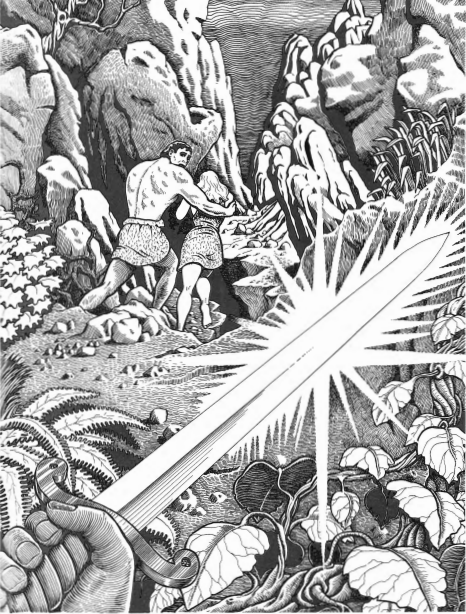
23Therefore YAHWEH God banished him from the Garden of Eden to work the ground from which he had been taken. 24So He drove out the man and stationed cherubim on the east side of the Garden of Eden, along with a whirling sword of flame to guard the way to the tree of life.
Genesis 3:20–24 Commentary
Eve, Mother of All — Scripture Knows No Lilith:
Adam names his wife Eve, meaning “living.” Scripture recognizes no earlier bride, no mythical Lilith lurking in the shadows. That belongs to later occult and Jewish folklore, not to the inspired text.
Garments of Skin — The First Animal Sacrifice:
God replaces their withered fig leaves with animal coats — requiring innocent blood to be shed to cover human guilt. This stands as the first biblical shadow of substitutionary sacrifice.
“One of Us” — God Blocks Access to Immortality:
“One of Us” reflects the exact same divine plurality we encountered back in Genesis 1:26 — the Father and the Word speaking in unified counsel. Sinful mankind cannot be permitted to live forever while alienated from God, so the way to the Tree of Life is blocked until the New Jerusalem, after Yeshua’s Millennial reign, restores it.
“Live Forever” vs. “Eternal” in Scripture:
Notice, too, what “live forever” in verse 22 (Genesis 3:22) does and doesn’t mean. There’s a difference Scripture never blurs: eternity — uncreated, without beginning, something only God has ever had — and immortality — unending life that was given, not inherently owned.
Immortality Belongs to Messiah Alone by Nature:
God isn’t saying Adam already possessed that first kind and merely risked losing it. As the Apostle Paul would emphasize millennia later in 1 Timothy 6:16, the Messiah “alone is immortal” by nature; immortality is not ours by default. What the Tree of Life offered Adam, and what the future resurrection will one day offer everyone in Messiah, is the second kind — unending life freely given, exactly as Paul would formulate to the Romans in Romans 6:23: “the wages of sin is death, but the gift of God is eternal life in Messiah Yeshua our Lord” Eden’s tree was the first sign of that gift. It would not be the last.
Eden’s Shut Door Previews Future Judgment:
Just as God shut Adam and Eve out of the garden, the Messiah will one day shut the door on those who practice lawlessness while claiming His name — a warning He would issue four millennia later in His earthly ministry in Matthew 7:21–23, telling the unrepentant, “I never knew you; depart from Me, you workers of lawlessness!” and picturing it again in the parable of the ten virgins in Matthew 25:11–12, where the door is finally closed; looking all the way to the final chapter of Scripture, the Apostle John in Revelation 22:2 reopens that tree to the redeemed at last, where “the leaves of the tree are for the healing of the nations.”
The Cherubim at the Gate May Echo Ezekiel 28:
Verse 24 (Genesis 3:24) posts cherubim on the east side of the garden, with a flaming sword, to guard the way to the Tree of Life. Cherubim are guardians. Thousands of years later, the prophet Ezekiel looks back in Ezekiel 28:14 and describes that very tempter in Eden as an anointed “guardian cherub” who once held a post of trust on “the holy mountain of God.” That raises a question Scripture doesn’t answer directly: after the serpent’s judgment, are these new cherubim taking over the post that guardian once held? It’s a possibility, and an interesting one, but treat it as exactly that. What is certain is that Eden’s door is guarded, and the way back to the tree stays shut until the closing vision of Revelation 22:2.
Cherubim — Fearsome Throne Sentinels, Not Winged Babies:
Western art and greeting cards have thoroughly corrupted the word “cherub,” turning it into a chubby, winged toddler with a toy harp. In Scripture, Cherubim (Keruvim) are the absolute opposite: they are terrifying, high-ranking cosmic sentinels and boundary-guardians of God's unapproachable holiness. Thousands of years later during the Babylonian exile, when the prophet Ezekiel sees them in Ezekiel 1:5–14 and Ezekiel 10:1–22, they are awe-inspiring composite living beings: each has four faces (a human, a lion, an ox, and an eagle), four wings (two stretched out to touch each other, and two covering their bodies), human hands beneath their wings, and straight legs ending in gleaming bronze hooves. They burn like white-hot coals and move with the speed of lightning bolts. God stationed these fearsome throne-guardians at Eden’s gate alongside a whirling blade of fire (Lahath HaCherev HaMithappekhet) — making it crystal-clear that fallen man could never storm his way back into God's presence.
Seraphim — Six-Winged Attendants of the Fiery Altar:
Revealed thousands of years later in Isaiah 6:1–7 during the prophet's temple vision, the Seraphim (derived from the Hebrew root saraph, meaning “to burn”) are literally the “Burning Ones.” Flying directly above the throne of YAHWEH, each possesses six wings: with two wings they cover their faces (shielding themselves from God's radiant glory), with two they cover their feet (an act of absolute humility in the divine presence), and with two they fly. They cry out in antiphonal roar: “Holy, holy, holy is YAHWEH of hosts; the whole earth is full of His glory!” Their touch carries the purifying fire of heaven — flying with live altar coals to purge human sin and prepare prophets for divine service.
Ophanim — Eye-Covered Wheels of God’s Mobile Throne:
Unveiled thousands of years later in the prophetic visions of Ezekiel 1:15–21, Ezekiel 10:9–17, and Daniel 7:9, the Ophanim (literally Hebrew for “wheels”) are living celestial structures carrying the chariot-throne of the Almighty. In his exilic vision, Ezekiel describes them as colossal, gleaming wheels within wheels, colored like sparkling beryl, with rims so high they inspired dread. Most striking of all, their outer rims are completely studded with eyes all around. Because the spirit of the living creatures resides within them, the wheels move synchronously in whichever direction the Spirit commands, without ever needing to turn. Writing from Babylon during the exile, the prophet Daniel confirms this throne architecture in Daniel 7:9, describing God’s throne ablaze with flames and its wheels burning with fire.
Michael — Scripture’s Only Explicitly Named Archangel:
Western folklore often speaks loosely of "the archangels," but biblical reality is far more disciplined. Down in the New Testament epistles, Scripture explicitly bestows the title "archangel" (archangelos—literally "chief or ruling messenger") on exactly one named individual: Michael (Jude 9). This does not necessarily mean Michael is the only archangel in existence. In fact, thousands of years after Eden, the prophet Daniel, writing from exile in Babylon, had recorded him designated as “one of the chief princes” (sarim harishonim in Daniel 10:13), implying there may well be other ruling princes in the heavenly realm. Furthermore, while the Apostle Paul, writing to the Thessalonians, declares in 1 Thessalonians 4:16 that the Lord will descend from heaven “with the voice of an archangel,” the Apostle does not identify that archangel by name; it could be Michael, or it could be another celestial commander. What Scripture reveals across Israel's prophetic history is that Michael is “the great prince who stands watch over your people” (Daniel 12:1)—the dedicated celestial field commander of Israel who, as the Apostle John foresaw in Revelation 12:7, leads the loyal heavenly armies in open warfare against the dragon.
Gabriel and Satan — Archangel Status Is Pure Speculation:
Popular tradition routinely groups Gabriel and Satan alongside Michael as a famous trio of "archangels," but that is an assumption of tradition rather than a stated fact of Scripture. Is it within the realm of possibility that they hold or held archangelic rank? Certainly. Thousands of years later in prophetic history, Gabriel is shown holding an immensely exalted post, standing in the direct presence of God (Luke 1:19) to deliver the Bible's most monumental messianic announcements: unlocking Daniel’s Seventy Weeks prophecy in Babylon (Daniel 8:16; 9:21) and delivering the virgin birth Annunciation to Mary in the Gospels (Luke 1:26–38). Likewise, the adversary wielded terrifying authority, eventually coercing a third of the celestial host into his rebellion. Because both figures possess personal names and elite power, readers naturally assume they must be archangels. Yet Scripture never once applies that title to either of them. In fact, the name “Lucifer” is not even the adversary’s biblical name — it is merely the fourth-century Latin Vulgate translation of the Hebrew Heylel (“shining one” or “day star”), recorded thousands of years later in Isaiah 14:12. As noted earlier, Ezekiel 28:14 designates the adversary as an anointed cherub, not an archangel. Acknowledging the possibility is fair, but dogmatically labeling Gabriel or Satan an archangel remains reader speculation, not biblical revelation.
Angelic Messengers — Spiritual Beings Manifesting in Human Form:
The common word for angel in both testaments — Hebrew Mal’akh and Greek Angelos—is a functional job description meaning “messenger.” As the Epistle to the Hebrews would explain millennia later, by nature these beings are created spirits (pneumata, Hebrews 1:14) belonging to the unseen celestial realm. However, whenever they are commissioned to deliver messages or interact directly with humanity on earth, Scripture consistently describes them visibly materializing in tangible human form as adult men (anashim) — as we will see in upcoming chapters with Abraham and Lot in Genesis 18:2 and Genesis 19:1–5, and four millennia later at the tomb of Messiah in Mark 16:5. Unlike the throne-room Cherubim and Seraphim, ordinary angelic messengers sent to earth are never described with wings in Scripture. They walk on physical roads, eat physical food, wash their feet, and can physically grasp human hands — looking so completely human that millennia later, the writer of Hebrews exhorts New Covenant believers that they might “entertain angels without knowing it” (Hebrews 13:2).
Genesis 3:1 Commentary
“Satan” and “Lucifer” Are Titles, Not Personal Names:
Looking all the way ahead to the book of Revelation, the Apostle John unmasks this Eden tempter as “that ancient serpent called the devil and Satan, the deceiver of the whole world” (Revelation 12:9). But keep the biblical vocabulary precise: “Satan” (Hebrew ha-satan) is not a personal name; it is a title meaning “the adversary” or “the accuser,” describing his ongoing hostile actions — not an original role God created him for, but what he chose to become: the one who, as Revelation 12:10 states, accuses the brethren before God day and night. Likewise, “Lucifer” is not his biblical name either — it is simply the fourth-century Latin Vulgate translation of the Hebrew poetic word Heylel (“shining one”) recorded thousands of years later by the prophet Isaiah (Isaiah 14:12). Scripture never confirms his true personal name anywhere in the Bible. While various traditions and scholars speculate names like Heylel or Azazel, there are no actual scriptural indications of his personal name, and all such claims are human speculation; his true name remains unknown to mankind.
Satan Paints God’s Protective Boundary as a Prison:
Here in Eden, humanity begins following his adversarial voice instead of trusting God. Notice his opening move: he does not attack God’s goodness head-on. He plants a deceptive question designed to make God’s protective boundary feel like a restrictive prison cell: “Did God really say, ‘You must not eat from any tree in the garden’?” That tactic has never gone out of style.
Nachash — The Shining Guardian Cherub of Eden:
Genesis 3:1 calls the tempter the nachash, usually translated “serpent,” but built on a Hebrew root associated with shining bronze or divination. Thousands of years later, the prophets would expose his true identity: Isaiah 14:12 describes him as the “shining one” (Heylel), and Ezekiel 28:13–15 identifies him as the anointed guardian cherub who was in Eden, the garden of God, blameless from the day he was created until wickedness was found in him. Prior to Eden, Scripture gives no record or logical inference that this being had rebelled.
Resentment of Humanity Sparked the Cherub’s Eden Fall:
What was the catalyst? While the prophet Isaiah would record thousands of years later his boastful ambition to make himself “like the Most High” (Isaiah 14:14), it is very likely that learning God’s ultimate plan for humanity — that dust-born creatures would bear the divine image, enter the divine family, and rule — sparked bitter resentment in this trusted spirit guardian. Intending to sabotage that plan, he deceived Eve to bring death into the physical world. His fall in Eden was not an eviction from the third heaven — as Ezekiel 28:17 would later explain, he was cast down to the ground outside of Eden, while the book of Job (Job 1:6) and the Apostle John's vision in Revelation 12 show he retained access to accuse God’s people in the heavenly court until his final end-times banishment.