Genesis 24
1By now Abraham was old and well along in years, and YAHWEH had blessed him in every way. 2So Abraham instructed the chief servant of his household, who managed all he owned, “Place your hand under my thigh, 3and I will have you swear by YAHWEH, the God of heaven and the God of earth, that you will not take a wife for my son from the daughters of the Canaanites among whom I am dwelling, 4but will go to my country and my kindred to take a wife for my son Isaac.”
5The servant asked him, “What if the woman is unwilling to follow me to this land? Shall I then take your son back to the land from which you came?”
6Abraham replied, “Make sure that you do not take my son back there. 7YAHWEH, the God of heaven, who brought me from my father’s house and my native land, who spoke to me and promised me on oath, saying, ‘To your offspring I will give this land’—He will send His angel before you so that you can take a wife for my son from there. 8And if the woman is unwilling to follow you, then you are released from this oath of mine. Only do not take my son back there.”
9So the servant placed his hand under the thigh of his master Abraham and swore an oath to him concerning this matter.
10Then the servant took ten of his master’s camels and departed with all manner of good things from his master in hand. And he set out for Nahor’s hometown in Aram-naharaim. 11As evening approached, he made the camels kneel down near the well outside the town at the time when the women went out to draw water.
12“O YAHWEH, God of my master Abraham,” he prayed, “please grant me success today, and show kindness to my master Abraham. 13Here I am, standing beside the spring, and the daughters of the townspeople are coming out to draw water. 14Now may it happen that the girl to whom I say, ‘Please let down your jar that I may drink,’ and who responds, ‘Drink, and I will water your camels as well’—let her be the one You have appointed for Your servant Isaac. By this I will know that You have shown kindness to my master.”
Genesis 24:9–14 Commentary
The Servant’s Sign Exposes Genuine Character:
The servant asks God for a sign specific enough to reveal both the woman’s character and God’s own guidance in the matter. A woman willing to draw water not just for a tired traveler but for his ten camels as well — animals that can drink enormous quantities after a journey — would be showing humility, diligence, hospitality, and a servant’s heart all in one gesture.
15Before the servant had finished praying, Rebekah came out with her jar on her shoulder. She was the daughter of Bethuel son of Milcah, the wife of Abraham’s brother Nahor. 16Now the girl was very beautiful, a virgin who had not had relations with any man. She went down to the spring, filled her jar, and came up again.
Genesis 24:15–16 Commentary
Immediate Answer — God Delivers Rebekah on Cue:
The servant’s prayer is barely finished before God answers it, right down to the smallest detail he asked for. Rebekah steps into view — Isaac’s first cousin once removed, the granddaughter of Abraham’s brother Nahor. The text specifies she was a virgin who had not had relations with any man, using the familiar Hebrew idiom that no man had “known” her (as seen five chapters earlier back in Genesis 19:8). Divine providence delivers the exact right woman at the exact right moment.
17So the servant ran to meet her and said, “Please let me have a little water from your jar.”
18“Drink, my lord,” she replied, and she quickly lowered her jar to her hands and gave him a drink.
19After she had given him a drink, she said, “I will also draw water for your camels, until they have had enough to drink.” 20And she quickly emptied her jar into the trough and ran back to the well to draw water, until she had drawn water for all his camels.
21Meanwhile, the man watched her silently to see whether or not YAHWEH had made his journey a success.
22And after the camels had finished drinking, he took out a gold ring weighing a beka, and two gold bracelets for her wrists weighing ten shekels. 23“Whose daughter are you?” he asked. “Please tell me, is there room in your father’s house for us to spend the night?”
Genesis 24:17–23 Commentary
Gold Gifts Signal a Serious Marriage Proposal:
When Rebekah calls the servant “my lord,” that is a respectful title fitting the culture, not an act of worship. The servant then gives her a gold nose ring and two gold bracelets — costly tokens that signal both the wealth of Abraham’s household and the seriousness of the proposal.
Is Jewelry Spiritually Dangerous? Ezekiel Says No:
The gifts of gold raise an ancient question. Nearly fifteen centuries later in Babylon, the prophet Ezekiel provides the definitive answer. In Ezekiel 16, God pictures His betrothal to Israel by describing how He personally adorned her with gold nose rings, earrings, and bracelets. Looking over six centuries ahead to the Law given at Mount Sinai, the second commandment (Exodus 20:4) outlaws making “an idol in the form of anything in the heavens above, on the earth below, or in the waters beneath” not jewelry worn for personal adornment.
24She replied, “I am the daughter of Bethuel, the son that Milcah bore to Nahor.” 25Then she added, “We have plenty of straw and feed, as well as a place for you to spend the night.”
26Then the man bowed down and worshiped YAHWEH, 27saying, “Blessed be YAHWEH, the God of my master Abraham, who has not withheld His kindness and faithfulness from my master. As for me, YAHWEH has led me on the journey to the house of my master’s relatives.”
Genesis 24:24–27 Commentary
The Lineage Checks Out — Rebekah Is Isaac’s Cousin:
Bowing his head, the servant worships YAHWEH alone, giving God the glory rather than honoring any person or object involved — displaying, over six centuries before Sinai, the exact opposite of the idolatry later codified in the Second Commandment (Exodus 20:5): “You shall not bow down to them or worship them.” The servant recognizes divine providence and immediately gives thanks.
28The girl ran and told her mother’s household about these things. 29Now Rebekah had a brother named Laban, and he rushed out to the man at the spring. 30As soon as he saw the ring, and the bracelets on his sister’s wrists, and heard Rebekah’s words, “The man said this to me,” he went and found the man standing by the camels near the spring.
31“Come, you who are blessed by YAHWEH,” said Laban. “Why are you standing out here? I have prepared the house and a place for the camels.” 32So the man came to the house, and the camels were unloaded. Straw and feed were brought to the camels, and water to wash his feet and the feet of his companions.
33Then a meal was set before the man, but he said, “I will not eat until I have told you what I came to say.” So Laban said, “Please speak.”
34“I am Abraham’s servant,” he replied.
Genesis 24:28–34 Commentary
Laban Greets the Servant with an Eye for Wealth:
Laban, Rebekah’s brother, enters the narrative — and notice what catches his eye first: the gold ring and bracelets on his sister’s wrists (Genesis 24:30), an early glimpse of the greedy streak Jacob will have to wrestle with decades down the road.
35“YAHWEH has greatly blessed my master, and he has become rich. He has given him sheep and cattle, silver and gold, menservants and maidservants, camels and donkeys. 36My master’s wife Sarah has borne him a son in her old age, and my master has given him everything he owns.
37My master made me swear an oath and said, ‘You shall not take a wife for my son from the daughters of the Canaanites in whose land I dwell, 38but you shall go to my father’s house and to my kindred to take a wife for my son.’
39Then I asked my master, ‘What if the woman will not come back with me?’
40And he told me, ‘YAHWEH, before whom I have walked, will send His angel with you and make your journey a success, so that you may take a wife for my son from my kindred and from my father’s house. 41And when you go to my kindred, if they refuse to give her to you, then you will be released from my oath.’
42So when I came to the spring today, I prayed: O YAHWEH, God of my master Abraham, if only You would make my journey a success! 43Here I am, standing beside this spring. Now if a maiden comes out to draw water and I say to her, ‘Please let me drink a little water from your jar,’ 44and she replies, ‘Drink, and I will draw water for your camels as well,’ may she be the woman YAHWEH has appointed for my master’s son.
45And before I had finished praying in my heart, there was Rebekah coming out with her jar on her shoulder, and she went down to the spring and drew water. So I said to her, ‘Please give me a drink.’
46She quickly lowered her jar from her shoulder and said, ‘Drink, and I will water your camels as well.’ So I drank, and she also watered the camels.
47Then I asked her, ‘Whose daughter are you?’ She replied, ‘The daughter of Bethuel son of Nahor, whom Milcah bore to him.’ So I put the ring on her nose and the bracelets on her wrists.”
Genesis 24:35–47 Commentary
God Hears Every Silent, Unspoken Prayer:
God’s providence in this mission began before the servant uttered a single audible word: he had prayed silently in his heart before opening his mouth (Genesis 24:45). King David would celebrate this exact intimacy over a thousand years later in Psalm 139:4: “Even before a word is on my tongue, You know all about it, O YAHWEH.” True prayer does not inform God of what He does not know; it aligns our will with His.
48“Then I bowed down and worshiped YAHWEH; and I blessed YAHWEH, the God of my master Abraham, who led me on the right road to take the granddaughter of my master’s brother for his son.
49Now if all of you will show kindness and faithfulness to my master, tell me; but if not, let me know, so that I may go elsewhere.”
50Laban and Bethuel answered, “This is from YAHWEH; we have no choice in the matter. 51Rebekah is here before you. Take her and go, and let her become the wife of your master’s son, just as YAHWEH has decreed.”
Genesis 24:48–51 Commentary
Bethuel and Laban Recognize God’s Hand:
Seeing the Almighty’s unmistakable guidance, Rebekah’s family consents to the marriage on the spot. What follows is the normal marriage pattern of the ancient Near East: families arranged it, and a woman typically moved from her father’s household into her husband’s. Marriage joined two households, not merely two individuals.
52When Abraham’s servant heard their words, he bowed down to the ground before YAHWEH. 53Then he brought out jewels of silver and gold, and articles of clothing, and he gave them to Rebekah. He also gave precious gifts to her brother and her mother. 54Then he and the men with him ate and drank and spent the night there. When they got up the next morning, he said, “Send me away to my master, all of you.”
55But her brother and mother said, “Let the girl remain with us ten days or so. After that, she may go.”
56But he replied, “Do not delay me, since YAHWEH has made my journey a success. Send me on my way so that I may go to my master.”
57So they said, “We will call the girl and ask her opinion.”
58They called Rebekah and asked her, “Will you go with this man?” “I will go,” she replied.
59So they sent their sister Rebekah on her way, along with her nurse and Abraham’s servant and his men. 60And they blessed Rebekah and said to her, “Our sister, may you become the mother of thousands upon thousands. May your offspring possess the gates of their enemies.”
61Then Rebekah and her servant girls got ready, mounted the camels, and followed the man. So the servant took Rebekah and left.
Genesis 24:52–61 Commentary
Rebekah’s Decisive Faith — “I Will Go”:
The family lets Rebekah herself decide whether to leave immediately, which stands out against the backdrop of arranged marriages driven almost entirely by family negotiation. Her decisive answer is faith expressed through action: she trusts God’s guidance and walks away from everything familiar into an unknown future.
Living Faith in Action — Echoes of James 2:
Two millennia later in the apostolic epistles, James makes this exact principle explicit: arguing from Abraham’s own life, he insists that faith without works is dead (James 2:20–22). Rebekah is living out that truth here, long before James ever put it into writing.
Rebekah’s Vow Shadows the Unseen Groom:
There’s a bigger picture in this scene, too. Rebekah’s response mirrors the calling of believers: agreeing to marry a Groom we have never seen, walking out a grueling lifelong journey guided by the Spirit, and ultimately being brought home to the Son.
Family Blessing Echoes the Abrahamic Promises:
As Rebekah departs, her family’s parting blessing repeats the very promises spoken earlier to Abraham in Genesis 17:16 and two chapters earlier in Genesis 22:17: “kings of peoples shall come from her” and her offspring will “possess the gate of his enemies.”
62Now Isaac had just returned from Beer-lahai-roi (for he was living in the Negev). 63Early in the evening, Isaac went out to the field to meditate, and looking up, he saw the camels approaching.
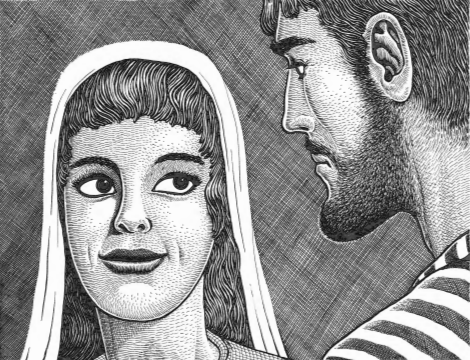
64And when Rebekah looked up and saw Isaac, she got down from her camel 65and asked the servant, “Who is that man in the field coming to meet us?” “It is my master,” the servant answered. So she took her veil and covered herself. 66Then the servant told Isaac all that he had done.
67And Isaac brought her into the tent of his mother Sarah and took Rebekah as his wife. And Isaac loved her and was comforted after his mother’s death.
Genesis 24:62–67 Commentary
Rebekah’s Veil Seals Her Vow to Isaac:
In Genesis 24:58, when asked if she would go with the servant, Rebekah gave her decisive answer: "I will go." In verse 65 (Genesis 24:65), when she learns Isaac is approaching across the field, she modestly covers herself with her veil — the tangible confirmation of the covenant vow she made before ever seeing him.
“Isaac Loved Rebekah” — Genuine Romantic Affection:
Genesis 24:67 records the poignant conclusion: "Isaac brought her into the tent of his mother Sarah and took Rebekah, and she became his wife, and he loved her." Scripture records this genuine affection directly, presenting Isaac and Rebekah as a tender portrait of marital devotion.
Genesis 24:1–8 Commentary
Abraham’s Final Covenant Mission for Isaac:
Abraham has one major covenant task left before he dies, and he is not about to compromise with the surrounding Canaanites. Three years have passed since Sarah’s death. Abraham is pushing 140, and Isaac is a 40-year-old bachelor. Abraham knows his own clock is ticking, making this a high-stakes rescue mission for the family line.
Eliezer — Chief Steward and Legal Proxy:
Moses pauses to note that Abraham is now an old man, crowned with years and sustained by God's faithfulness, before launching into this pivotal mission. While the trusted servant sent on the journey is left unnamed here, he is almost certainly Eliezer of Damascus — whose name means “my God is help” — the veteran chief steward originally introduced nine chapters earlier back in Genesis 15:2. Eliezer isn't merely running a domestic family errand; he carries the full legal proxy of the patriarch to secure the covenant seed.
YAHWEH’s Angel Goes Ahead of the Servant:
Abraham requires an oath sworn in God’s name, a solemn vow binding the servant to God Himself as witness and guarantor. When the servant reaches his destination, he prays for YAHWEH to show chesed toward Abraham (Genesis 24:12) — not mere politeness, but the weightier covenant loyalty Scripture uses for God’s own steadfast love toward His people.
The Thigh Oath — Sworn on the Covenant Seed:
Verse 2 (Genesis 24:2) has Abraham tell his servant to put his hand under his thigh while he swears. The Hebrew word, Yarek, is the thigh or loins, the seat of descendants (as seen down the corridor of patriarchal history when Genesis 46:26 describes Jacob’s offspring as those who came from his thigh). Many read the gesture as a solemn vow sworn on the lineage itself, the very seed God had previously promised and sealed with circumcision seven chapters earlier back in Genesis 17:10–14. Later in our account, Jacob will ask Joseph for this exact same oath in Genesis 47:29. If that reading is right, the oath carries enormous weight: the servant is swearing by the promised Seed while on a mission to find the Seed’s mother.
Prophetic Shadow — Father, Son, and Guiding Helper:
This entire chapter functions as a stunning prophetic picture: Abraham is a type of the Father, Isaac is a type of Messiah, and Eliezer (God is my help) is a type of the Holy Spirit. Now, keep your theology straight: the Holy Spirit is not some third person of a Trinity, but the active, personal power of God. Still, as the Helper sent to select and guide the Bride, the physical analogy is absolutely perfect.
Protecting Isaac From Canaanite Idolatry:
Abraham’s concern here has nothing to do with ethnicity; it has everything to do with idolatry. He is fiercely protecting Isaac from being seduced into Canaanite paganism through marriage, the exact spiritual catastrophe God would warn all Israel against over six centuries later through Moses at Mount Sinai: “And when you take some of their daughters as brides for your sons, their daughters will prostitute themselves to their gods and cause your sons to do the same” (Exodus 34:16). Forty years later on the plains of Moab, Moses reiterated the same command: “Do not intermarry with them... because they will turn your sons away from following Me to serve other gods” (Deuteronomy 7:3–4). The bride had to come from Abraham’s extended family line to preserve the spiritual integrity of the household. Yet Abraham’s equal priority was that Isaac never set foot back in Mesopotamia himself. YAHWEH had called Abraham out of that pagan land, and he had zero intention of letting the covenant heir drift back into the spiritual quicksand his father had abandoned.