Genesis 25
1Now Abraham had taken another wife, named Keturah, 2and she bore him Zimran, Jokshan, Medan, Midian, Ishbak, and Shuah.
3Jokshan was the father of Sheba and Dedan. And the sons of Dedan were the Asshurites, the Letushites, and the Leummites.
4The sons of Midian were Ephah, Epher, Hanoch, Abida, and Eldaah. All these were descendants of Keturah.
5Abraham left everything he owned to Isaac. 6But while he was still alive, Abraham gave gifts to the sons of his concubines and sent them away from his son Isaac to the land of the east.
7Abraham lived a total of 175 years. 8And at a ripe old age he breathed his last and died, old and contented, and was gathered to his people.
9His sons Isaac and Ishmael buried him in the cave of Machpelah near Mamre, in the field of Ephron son of Zohar the Hittite. 10This was the field that Abraham had bought from the Hittites. Abraham was buried there with his wife Sarah.
11After Abraham’s death, God blessed his son Isaac, who lived near Beer-lahai-roi.
Genesis 25:7–11 Commentary
Abraham Knew Jacob and Esau for Fifteen Years:
Genesis 25:8 records that Abraham died at one hundred and seventy-five years old, “an old man and full of years, and he was gathered to his people.” Chronological calculation reveals that Abraham lived long enough to personally know his twin grandsons, Jacob and Esau, until they were fifteen years old. Although the twins are not introduced until a few verses ahead in this same chapter (Genesis 25:24–26), Isaac was sixty years old when they were born. Since Abraham was a hundred when Isaac arrived four chapters earlier (Genesis 21:5), the patriarch was one hundred and sixty when the boys were born, giving him fifteen full years with them before his death. Moses deliberately wraps up Abraham’s life and burial first, allowing the biographical narrative to run ahead of the strict family chronology.
Isaac Inherits the Sole Covenant Blessing:
Abraham is buried in the cave of Machpelah — reuniting Isaac and Ishmael at his tomb (Genesis 25:9) — in the exact plot he had purchased two chapters earlier in Genesis 23. With Abraham gone, God continues His covenant blessing through Isaac specifically, the promised son whose birth had already fulfilled God’s earlier word to Abraham four chapters back in Genesis 21:1–3.
12This is the account of Abraham’s son Ishmael, whom Hagar the Egyptian, Sarah’s maidservant, bore to Abraham. 13These are the names of the sons of Ishmael in the order of their birth: Nebaioth the firstborn of Ishmael, then Kedar, Adbeel, Mibsam, 14Mishma, Dumah, Massa, 15Hadad, Tema, Jetur, Naphish, and Kedemah.
16These were the sons of Ishmael, and these were their names by their villages and encampments—twelve princes of their tribes. 17(Ishmael lived a total of 137 years. Then he breathed his last and died, and was gathered to his people.)
Genesis 25:12–17 Commentary
Ishmael’s Twelve Princes Fulfill God’s Promise:
Exactly as foretold eight chapters earlier in Genesis 17:20, twelve tribal rulers descend from Ishmael — a fascinating parallel to the twelve sons of Jacob. Ishmael dies at a hundred thirty-seven, human lifespans still declining after the Flood, consistent with the limits decreed all the way back before the Flood in Genesis 6:3.
Kedar and Nebaioth Show Up in the Kingdom:
Ishmael’s firstborn, Nebaioth, and his second son, Kedar (Genesis 25:13), are not forgotten. Looking over a thousand years down the prophetic horizon, the prophet Isaiah in Isaiah 60:7 pictures the flocks of Kedar and the rams of Nebaioth coming up to serve on YAHWEH’s altar in the age to come. The line God had promised eight chapters earlier back in Genesis 17:20 to make into a great nation ends up with a place at the altar. God’s promise to Ishmael wasn’t a consolation prize. It runs all the way to the Kingdom.
18Ishmael’s descendants settled from Havilah to Shur (which is near the border of Egypt as you go toward Asshur). And they lived in hostility toward all their brothers.
19This is the account of Abraham’s son Isaac. Abraham became the father of Isaac, 20and Isaac was forty years old when he married Rebekah, the daughter of Bethuel the Aramean from Paddan-aram and the sister of Laban the Aramean.
21Later, Isaac prayed to YAHWEH on behalf of his wife, because she was barren. And YAHWEH heard his prayer, and his wife Rebekah conceived.
22But the children inside her struggled with each other, and she said, “Why is this happening to me?” So Rebekah went to inquire of YAHWEH, 23and He declared to her: “Two nations are in your womb, and two peoples from within you will be separated; one people will be stronger than the other, and the older will serve the younger.”
Genesis 25:18–23 Commentary
Ishmael’s Story Closes and Isaac’s Begins — Another Barren Wife:
Verse 18 (Genesis 25:18) closes Ishmael’s account by recording that his descendants settled in hostility toward all their brothers, fulfilling the exact prophecy spoken nine chapters earlier back in Genesis 16:12. Then the narrative turns to Isaac, who marries Rebekah, “the daughter of Bethuel the Aramean.” Like Sarah before her, Rebekah is barren. Isaac prays for her, and God answers.
Biblical Personhood Begins at Conception in the Womb:
Scripture refers to the twins while they are still in the womb as full human beings, language that affirms life from conception. It is the same eternal truth King David will marvel at over a thousand years later in Psalm 139:13–16, where he describes God forming him and knitting him together while he was still in his mother’s womb; the same truth God will declare nearly fifteen centuries later to the prophet Jeremiah (Jeremiah 1:5), that He knew him before he was ever formed there; and the same truth John the Baptist will live out two millennia later in the Gospels by leaping in Elizabeth’s womb at the sound of Mary’s greeting (Luke 1:41).
Ratsats — A Violent Collision in the Womb:
When Rebekah feels the chaos inside her in Genesis 25:22, Moses uses the vivid Hebrew verb ratzatz — meaning to crush, fracture, or violently collide. This wasn't a gentle prenatal flutter; it was an all-out wrestling match in the womb between two divergent nations, foreshadowing centuries of geopolitical conflict.
24When her time came to give birth, there were indeed twins in her womb. 25The first one came out red, covered with hair like a fur coat; so they named him Esau. 26After this, his brother came out grasping Esau’s heel; so he was named Jacob. And Isaac was sixty years old when the twins were born.
27When the boys grew up, Esau became a skillful hunter, a man of the field, while Jacob was a quiet man who stayed at home. 28Because Isaac had a taste for wild game, he loved Esau; but Rebekah loved Jacob.
Genesis 25:24–28 Commentary
Jacob’s Name — Heel-Grabber and Supplanter:
In Genesis 25:25, the first twin is born "red, all over like a hairy garment, so they named him Esau." Immediately following, Jacob emerges grasping his brother’s heel (in Hebrew, Ya'aqov, derived from the root aqev, meaning heel or supplanter).
Jacob Stayed at Home — Estate Manager, Not Idler:
When Genesis 25:27 describes Jacob as “a quiet man who stayed at home” — where the Hebrew behind “stayed at home” is literally “dwelling in tents” (yoshev ohalim), and “quiet” translates the Hebrew word tam, meaning sound, upright, or settled — this does not mean he was a lazy idler. In patriarchal culture, it designates an estate manager skilled in domestic administration and livestock operations, in contrast to Esau’s wild, nomadic hunting lifestyle.
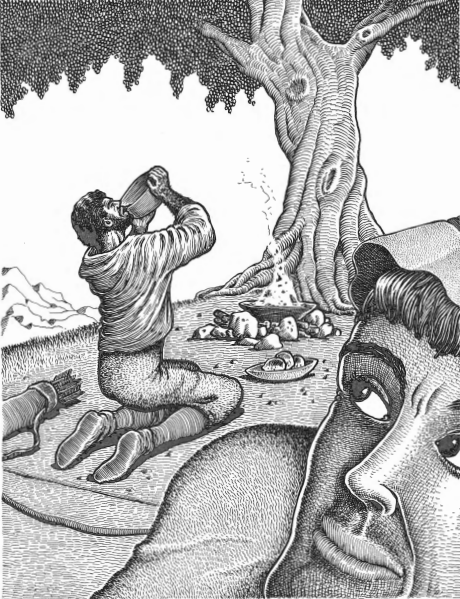
29One day, while Jacob was cooking some stew, Esau came in from the field and was famished. 30He said to Jacob, “Let me eat some of that red stew, for I am famished.” (That is why he was also called Edom.)
31“First sell me your birthright,” Jacob replied.
32“Look,” said Esau, “I am about to die, so what good is a birthright to me?”
33“Swear to me first,” Jacob said. So Esau swore to Jacob and sold him the birthright. 34Then Jacob gave some bread and lentil stew to Esau, who ate and drank and then got up and went away. Thus Esau despised his birthright.
Genesis 25:29–34 Commentary
Unbridled Appetite Names Edom for Life:
In Genesis 25:30, Esau's unrefined appetite takes over: “Please let me have a swallow of that red stuff, for I am exhausted!” The rare Hebrew verb halitehni literally means to gulp greedily without chewing — he was practically grunting: Let me gulp down that red, red broth! In a single moment of reckless belly-worship, he forfeited the spiritual birthright of the patriarchs.
Archaeology Confirms Birthrights Were Legally Sold:
Esau’s claim that he was on the verge of death was pure melodrama, and Jacob took immediate advantage of his brother’s contempt for the covenant inheritance to lock the transaction in on the spot. Ancient Hurrian legal contracts unearthed at Nuzi prove that birthrights and inheritance portions were routinely sold, traded, and legally transferred between brothers in the second millennium BC — including a documented tablet where a brother legally transferred his paternal inheritance share in exchange for three sheep. Jacob was not playing games; he understood ancient Near Eastern contract law, demanded a binding sworn oath, and secured an ironclad legal deed to the birthright.
Hebrews Warns Against Esau’s Fatal Bargain:
Two millennia later in the apostolic writings, the author of Hebrews holds Esau up as a terrifying warning: “godless like Esau, who for a single meal sold his birthright” (Hebrews 12:16), and who, when he later desired to inherit the blessing, was rejected and found no chance to repent, though he sought it with tears.
Paul’s Warning — “Their God Is Their Belly”:
Looking two millennia ahead to the apostolic epistles, the Apostle Paul captures the exact spiritual sickness Esau embodies in Philippians 3:19: “Their end is destruction, their god is their belly, and their glory is in their shame. Their minds are set on earthly things.” Esau traded an eternal inheritance for thirty seconds of immediate physical gratification.
Genesis 25:1–6 Commentary
Keturah — A Name Scented With Altar Incense:
With Sarah dead, Abraham takes another wife, Keturah — a name derived from the Hebrew Qatar, meaning to burn incense. Scripture presents nothing sinful in that marriage. To protect Isaac’s inheritance, Abraham gives gifts to the sons of his concubines — primarily Keturah’s sons, alongside the earlier departure of Hagar’s line — and sends them eastward, away from Isaac, into the lands of the east.
Keturah’s Descendants Spread Across Ancient Arabia:
Historical geography tracks the aggressive expansion of Keturah’s sons across the ancient Near East. Scripture locates them throughout Arabia and the vast desert territories east of Canaan: Midian east of the Jordan, and Sheba and Dedan deep in Arabia (Genesis 25:3). Over six centuries later during the Exodus, Moses’ father-in-law Jethro was himself a Midianite priest descended from this exact line (Exodus 2:16–18; 3:1). Within Church of God historical teaching, the migrations of these energetic eastern tribes are traced even further, identifying their movements among foundational peoples of both the Middle East and parts of Eastern Europe.
Is Keturah Actually Hagar? Scripture Says No:
An old Jewish tradition, found in Genesis Rabbah and in Rashi, identifies Keturah with Hagar, claiming Isaac went to Beer-lahai-roi one chapter earlier in Genesis 24:62 to bring her back to Abraham. But Genesis never equates the two women. In fact, looking fifteen centuries ahead to the post-exilic genealogies, 1 Chronicles 1:32 calls Keturah Abraham’s concubine, while Genesis 25:1 calls her a wife.